Sign of Progress (Early Indicator)
Kentucky’s college-going rate matters as an important lagging indicator that reflects the cumulative impact of academic preparation, financial readiness, career guidance, and cultural factors that influence student decisions about continuing education immediately after high school. The college-going rate is the percent of recent Kentucky high school graduates who attend any in-state or out-of-state postsecondary institution in the summer, fall or spring following high school graduation. As of 2024, Kentucky’s college-going rate was 53.3%.

Source: Kentucky Center for Statistics (KY STATS)
The college-going rate is a critical indicator of a community’s ability to thrive economically, socially, and culturally. It impacts factors such as workforce competitiveness, innovation, social mobility, civic engagement, health, and cultural enrichment. College-educated individuals typically earn higher incomes, contribute more to taxes, and drive local consumer spending that stimulates economic development. In today’s knowledge-driven economy, a higher college-going rate strengthens a skilled workforce and attracts businesses seeking educated talent. College-educated individuals are more likely to engage in civic activities, such as voting and volunteering, and they tend to have better health outcomes overall.
This broader context of postsecondary value underscores why college-going rate remains a vital metric, especially when viewed through Lumina Foundation’s “Credentials of Value” framework, which measures whether degrees, certificates, and certifications actually lead to economic prosperity. Lumina’s Goal 2040 aims for 75 percent of adults in the U.S. labor force to have college degrees or other credentials of value that enable workers to earn at least 15% more than the national median salary of high school graduates. While Kentucky’s college-going rate captures immediate enrollment decisions, it serves as a critical early indicator of whether the state is positioning its residents to access these higher-value credentials. Given that research shows higher levels of education are often linked to greater economic prosperity, and that the Georgetown Center projects 72% of jobs will require postsecondary education by 2031, Kentucky’s college-going rate reflects the state’s capacity to prepare residents for an economy where postsecondary credentials—whether traditional degrees or alternative certifications—are increasingly essential for economic mobility and community prosperity.
However, it’s important to recognize and support other transition pathways beyond immediate college enrollment. These pathways include students joining the military, entering the workforce in positions with wages that can support a family, or participating in registered apprenticeships. This metric must be interpreted carefully within the broader context of changing economic conditions, evolving career pathway options, and shifting student priorities about the value and timing of postsecondary education.
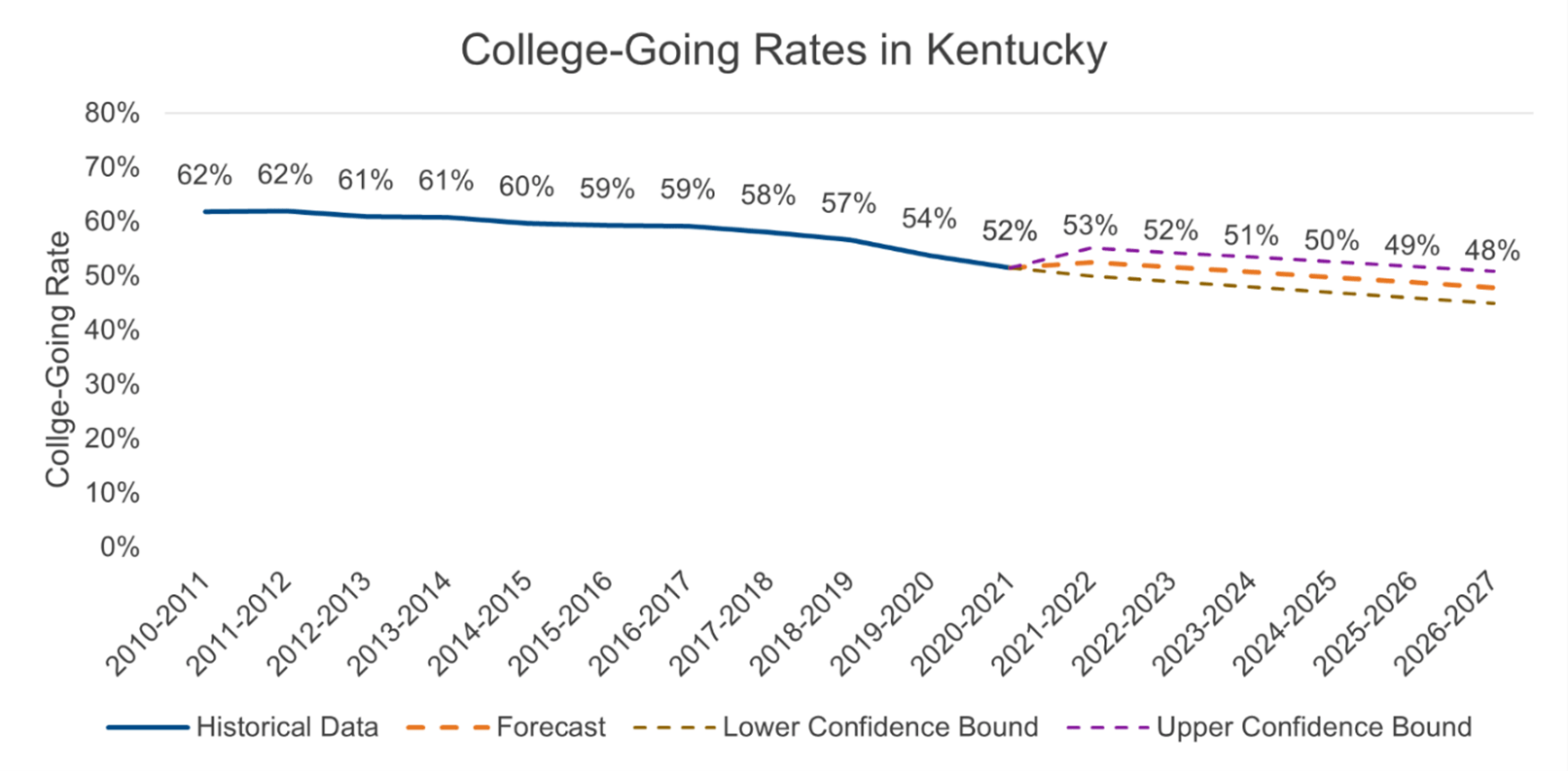
Kentucky’s rate represents a decline from historical levels, indicating significant shifts in student postsecondary behavior and priorities that reflect multiple trends including increased awareness of college costs and student debt concerns, expanded recognition of alternative career pathways that provide economic success without traditional four-year degrees, immediate employment opportunities in growing industries, and changing employer requirements that may not require college degrees for entry-level positions.
The decline in immediate college enrollment does not necessarily indicate educational failure or reduced student ambition. Research shows that not all students benefit from immediate postsecondary enrollment, and some may achieve better outcomes through gap years, workforce entry, apprenticeships, or military service before pursuing continued education. Additionally, immediate enrollment does not predict completion, and students who delay postsecondary education may ultimately achieve higher success rates when they enroll with clearer goals and greater motivation.
However, the college-going rate serves as a lagging indicator because it reflects the cumulative impact of educational policies, economic conditions, and social factors that influence student preparation and decision-making throughout their K-12 experience. Changes in academic rigor, career guidance, or college preparation programs may not affect college-going rates for several years, making this metric valuable for long-term evaluation while requiring complementary leading indicators for immediate program improvement.
The implications of college-going rate changes extend beyond individual student outcomes to affect Kentucky’s long-term economic competitiveness and educational planning. Declining rates may indicate that educational systems are not adequately preparing or motivating students for postsecondary success, or they may reflect positive trends toward diversified career pathways that better match student interests and economic opportunities.
For Kentucky specifically, the college-going rate must be evaluated alongside other indicators including postsecondary completion rates, employment outcomes, and workforce participation to understand whether changes reflect student choice or systemic barriers. The Georgetown Center on Education and the Workforce projects that by 2031, 72% of jobs will require postsecondary education or training, suggesting that reduced immediate college enrollment could create long-term economic challenges unless alternative credential pathways provide equivalent opportunities.
Kentucky’s challenge lies in ensuring that college-going rate changes reflect informed student choices rather than barriers to access or inadequate preparation. This requires comprehensive analysis of why students choose different pathways and whether these decisions align with long-term career goals and economic opportunities. District-level college-going rate data can be found at KyStats, in the Kentucky School Report Card and Prichard Committee Community Profiles. If Kentucky makes no changes, the state’s college-going rate is likely to continue to trend downward based on current trajectory analysis.
Figure 3
College-Going Rates in Kentucky: Historical Data and Forecast Trend
 Source: Kentucky Department of Education (KDE) School Report Card
Research evidence on college-going rates reveals complex relationships between immediate enrollment patterns and long-term student success. The National Student Clearinghouse research tracking students over multiple years shows that immediate college enrollment does not guarantee degree completion, while some students who delay enrollment ultimately achieve better outcomes when they enter with clearer goals and greater maturity.
National Association for College Admission Counseling research identifies multiple factors influencing college-going decisions including academic preparation, financial considerations, family expectations, career guidance quality, and cultural factors. Their studies show that students with strong academic preparation and comprehensive guidance are more likely to make informed decisions that align with their long-term goals, regardless of immediate enrollment choices.
The Federal Reserve Bank economic research on college enrollment trends shows that immediate college-going rates often correlate with local economic conditions, with stronger job markets sometimes reducing immediate enrollment as students choose workforce entry over continued education. However, their analysis also shows that students entering the workforce without postsecondary credentials may face limited advancement opportunities and wage growth over time.
Community College Research Center studies demonstrate that two-year college enrollment patterns differ significantly from four-year institution trends, with community colleges serving more students who delay enrollment, attend part-time, or combine work and education. Their research shows that flexible enrollment options can support student success for those who might not succeed in traditional immediate enrollment patterns.
Research on financial barriers to college enrollment reveals that concerns about student debt and college affordability significantly influence student decisions about immediate enrollment. Federal Reserve Bank analysis shows that students from low-income families are particularly sensitive to financial considerations, even when grant aid is available, suggesting the need for better information and support around college financing.
Economic research on alternative pathways demonstrates that some career routes provide economic opportunities comparable to traditional college graduates, particularly in skilled trades, technology, and healthcare fields that may require industry certifications or associate degrees rather than bachelor’s degrees. However, studies also show that workers without postsecondary credentials face greater vulnerability to economic disruption and technological change.
The Hechinger Report analysis of state college-going trends shows significant variation across regions and demographic groups, with rural students, first-generation college students, and students from low-income families showing lower immediate enrollment rates despite potentially benefiting most from postsecondary education.
However, longitudinal research by National Bureau of Economic Research reveals that delayed college enrollment can produce positive outcomes when students gain work experience, clarify career goals, or improve academic preparation before entering postsecondary education. Studies show that “non-traditional” students often demonstrate higher motivation and completion rates compared to traditional immediate enrollees.
Research on state policies shows that college-going rates can be influenced by state investment in financial aid, college preparation programs, and alternative pathway development. States that maintain robust support for diverse postsecondary options often show more stable enrollment patterns that reflect student choice rather than systemic barriers.
Economic mobility research emphasizes that while college education remains an important pathway to economic advancement, the relationship between immediate enrollment and long-term success is complex. Studies show that students who make informed decisions about timing and type of postsecondary education based on career goals and personal circumstances often achieve better outcomes than those who enroll immediately without clear direction.
Research on alternative credentials and industry partnerships demonstrates growing opportunities for economic success through non-traditional pathways. However, studies also emphasize the importance of ensuring these alternatives provide genuine preparation for career advancement and economic mobility rather than dead-end positions with limited growth potential.