| HB | 1 | The bill creates a new section in KRS Chapter 14 allowing the Commonwealth to opt into the federal qualified elementary and secondary education scholarship tax credit program. It designates the Secretary of State as the sole official responsible for notifying the U.S. Secretary of the Treasury, submitting required documentation, publishing regulations and guidance online, and administering the program. The Secretary of State is authorized to promulgate administrative regulations, collect fees, and accept private contributions to cover administrative costs, with specific requirements for managing those funds. The bill also waives Eleventh Amendment immunity for matters related to the section and amends KRS 141.019 to exclude qualified contributions to scholarship granting organizations from Kentucky individual income tax dedications. | K. Moser, T. Roberts, D. Osborne | Veto overriden; Delivered to Secretary of State |
| HB | 5 | Establishes a prison education and job training program through the Kentucky Community and Technical College System and the Kentucky Department of Corrections at Northpoint Training Center; sets eligibility criteria; creates a certificate of employability upon completion; and revises public employment and occupational licensing laws to limit disqualification based solely on prior convictions. | J. Decker, D. Osborne, R. Bridges, E. Callaway, J. Calloway, R. Duvall, D. Elliott, K. Fleming, C. Freeland, D. Gordon, P. Griffee, M. Hart, T. Huff, M. Imes, K. Jackson, S. Lewis, M. Lockett, B. McCool, S. McPherson, D. Meade , S. Miles, K. Moser, A. Neighbors, J. Nemes, M. Proctor, T. Roberts, S. Rudy, N. Tate, T. Truett, M. Whitaker, R. White, N. Wilson, S. Witten | Delivered to Governor |
| HB | 11 | Establishes a statutory process for creating new independent school districts from persistently underperforming districts, including local ballot approval, provisional governance, and interim boards of education. Sets requirements for transitioning authority, dividing assets, liabilities, and tax revenues, and outlines KDE’s role in calculations, oversight, and technical assistance. Provides timelines, dispute resolution, and funding transition provisions, allows temporary waivers and service contracts, and creates a first-year funding projection model for both the new and remaining districts. | J. Bauman | No action |
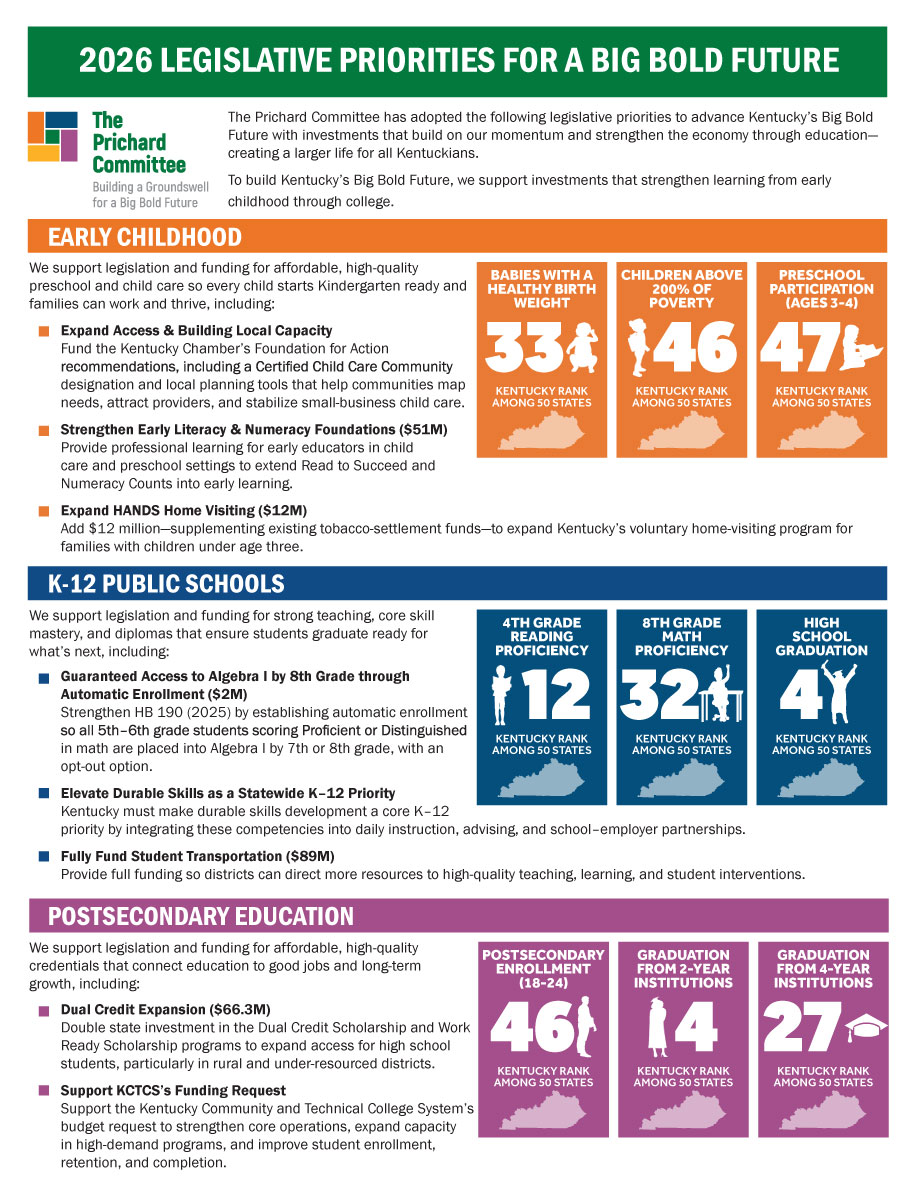
| HB | 35 | Includes proprietary schools as eligible institutions for both the Dual Credit Scholarship Program and the Work Ready Kentucky Scholarship Program. | K. Banta | No action |
| HB | 44 | Creates the Robotics Competition Fund and a selection committee to award grants to eligible robotics teams and sponsors, sets committee membership and duties, requires KDE to establish grant procedures, sets application and reporting requirements, and provides implementation timelines. Titled the Advanced Manufacturing Through Robotics Education Act. | C. Lewis, E. Callaway, P. Griffee, D. Grossberg, T. Huff, J. Nemes | Awaiting committee in Senate |
| HB | 47 | Require Kentucky State Police posts to enter into agreements with the United States Immigration and Customs Enforcement to participate in the Task Force Model Program; require Kentucky State Police officers who participate in the Task Force Model Program to complete Immigration and Customs Enforcement training; amend KRS 15.404 to provide that any peace officer who completes Immigration and Customs Enforcement training will be deemed to have completed annual in-service training | T. Roberts, S. Baker, K. Banta, R. Bivens | No action |
| HB | 49 | Establishes the Kentucky Professional Engineer and Professional Land Surveyor Incentive Scholarship Fund to provide postsecondary scholarships to Kentucky residents pursuing engineering or land surveying. Recipients must obtain licensure within six years and practice in-state, with enforcement provisions for noncompliance, and the board must report annually to the legislature. | E. Callaway, M. Koch | Signed by Governor |
| HB | 67 | Amends KRS 160.145 to refine rules on unauthorized electronic communication between school personnel and students by limiting the scope to private electronic communication, defining key terms, and expanding coverage to certain assigned staff. Clarifies parental consent requirements, allows revocation and multiple designees, and prohibits schools from conditioning student participation on consent forms. Establishes reporting standards, parental notification requirements, investigative procedures, disciplinary flexibility for districts, and specified exceptions (including emergencies, field trips, work-based learning, and disclosed affiliations). EMERGENCY. | J. Payne, P. Flannery, S. Rudy | Delivered to Governor; SB 3 language added to amendment |
| HB | 88 | Allows Kentucky to participate in the federal Qualified Education Scholarship Tax Credit Program, designates the Auditor of Public Accounts to submit the state’s election and maintain a list of scholarship-granting organizations, and authorizes the Auditor to set rules and enter agreements to implement the program. | T. Roberts | No action |
| HB | 94 | Requires the Council on Postsecondary Education to create and maintain statewide transfer pathways for selected baccalaureate programs, publish them online, ensure participating institutions accept transfer credits as general education or program-specific general education, and coordinate curriculum changes affecting lower-division courses. | V. Grossl | Awaiting Passage in the House; filed via HFA to SB 22 & SB 249 |
| HB | 99 | Establishes a process for creating new independent school districts in qualifying cities, including voter petitions, interim board elections, and transition of authority, assets, debts, and taxes from the originating district; requires the interim board to develop a transition plan, allows temporary waivers and service contracts, and sets up a state funding projection model for the first year of operations. | J. Tipton | No action |
| HB | 321 | Allows certified family child-care home providers and licensed Type II child-care centers to participate in the Child Care Assistance Program, defines applicable terms, and sets participation requirements related to providers’ own children and nonrelative children served through the program. | V. Grossl | No action |
| HB | 322 | Exempts child-care providers located on military installations or facilities from state certification requirements if they are licensed or certified by the U.S. Department of Defense, a branch of the U.S. Armed Forces, the National Guard, or a reserve component. | V. Grossl | No action |
| HB | 328 | Establishes licensure requirements and operational standards for child-care centers by amending existing statutes governing child-care center regulation. | N. Wilson | No action |
| HB | 379 | Updates postsecondary governance statutes by eliminating obsolete definitions and repealing outdated provisions, formally codifying the Commonwealth Education Continuum, and establishing its governance, membership, duties, staffing, and annual reporting requirements. The bill also attaches the Board of Student Body Presidents to the Council on Postsecondary Education for administrative purposes and makes conforming technical changes. | S. Baker | Vetoed |
| HB | 469 | Requires candidates and appointees for local boards of education to obtain a KDE-issued certificate of qualification, including background and CA/N checks, to appear on the ballot, run as a write-in, or be appointed. Establishes a statewide code of ethics for school board members with an investigation and public reprimand process, updates eligibility and filing requirements, protects current members during their terms, and phases in key provisions beginning January 1, 2027. | R. Bivens, J. Hodgson, K. Jackson, J. Payne, T. Truett | Awaiting assignment in the Senate |
| HB | 513 | Eliminates separate funding calculations for kindergarten, removes half-day program provisions, and aligns related statutes; effective July 1, 2027. | S. Stalker, T. Truett | No action |
| HB | 562 | Requires the Kentucky Board of Education to establish regulations for an alternate high school diploma and a modified high school diploma, including specific eligibility and completion requirements. Directs the Department of Workforce Development to develop and publish a list of employers willing to hire individuals with an alternate high school diploma. Makes conforming amendments to related education and postsecondary statutes. | T. Truett, C. Fugate, S. Baker, R. Bivens, J. Blanton, D. Fister, P. Flannery, D. Gordon, T. Huff, K. Jackson, W. Lawrence, D. Lewis, S. Lewis, S. McPherson, M. Pollock, T. Smith, B. Wesley | Signed by Governor |
| HB | 564 | Requires that certified school personnel be compensated for mandatory professional development activities that occur outside the scheduled school calendar or regular work hours. | C. Aull | No action |
| HB | 572 | Expands access to preschool by requiring districts to serve 4-year-olds from households at or below 160% of the poverty level through the 2030–2031 school year and, beginning in 2031–2032, all 4-year-olds who are at risk. The bill defines key terms, sets program guidelines, requires use of fully utilized Head Start capacity, and directs districts to submit preschool expansion plans. It also requires KDE to establish a statewide unified data system, promulgate regulations, enforce penalties for noncompliance, and report annually to the Legislative Research Commission on preschool expansion progress. | T. Bojanowski, A. Donworth, G. Brown Jr., L. Burke, A. Camuel, B. Chester-Burton, A. Gentry, M. Marzian, A. Moore, R. Roarx, S. Stalker, P. Stevenson, A. Tackett Laferty, J. Watkins, L. Willner | No action |
| HB | 574 | Expands preschool access by requiring school districts to serve 4-year-olds from households at or below 160% of the poverty level through the 2033–2034 school year and, beginning in 2034–2035, all eligible children. The bill defines key terms, sets program guidelines, and requires districts to confirm full use of Head Start capacity and submit preschool expansion plans. It also directs KDE to establish a unified statewide data system, promulgate administrative regulations, enforce penalties for noncompliance, and report annually to the Legislative Research Commission on preschool expansion progress. | A. Donworth, T. Bojanowski, C. Aull, G. Brown Jr., L. Burke, A. Camuel, B. Chester-Burton, A. Gentry, E. Hancock, M. Lehman, M. Marzian, A. Moore, R. Roarx, S. Stalker, P. Stevenson, J. Watkins | No action |
| HB | 591 | Requires the Kentucky Department of Education to develop a career and technical education program or pathway focused on performing arts. | S. Bratcher | No action |
| HB | 609 | Establishes the Classroom Library Grant Program within KRS Chapter 158, defining key terms and directing the Kentucky Department of Education to implement the program through a designated program administrator. Sets qualifications and responsibilities for the administrator and appropriates $5 million from the General Fund to support classroom libraries statewide. | K. Jackson, C. Fugate, S. Lewis, A. Neighbors, S. Riley, T. Truett, L. Willner | No action |
| HB | 610 | Requires teachers to be paid for noninstructional planning time during the school day when they are required to supervise or instruct students. | C. Massroni | No action |
| HB | 619 | Expands and restructures the KCTCS Board of Regents, shortens member terms, and strengthens attendance and eligibility rules. Clarifies the roles of the board, president, and new chief financial officer, increases board oversight of budgeting, and requires legislative approval and reporting for major structural changes to colleges, campuses, or programs. Creates a board of advisors and repeals outdated statutes. | J. Bray and J. Petrie | Delivered to Governor |
| HB | 621 | Requires the Kentucky Department of Education to issue regulations enforcing maximum class sizes and caseload limits for exceptional children and youth. Defines “caseload” and “special classes,” and makes conforming and technical updates to related statutes. | T. Bojanowski, J. Nemes, K. Banta, L. Burke, A. Camuel, B. Chester-Burton, A. Gentry, S. Heavrin, K. Jackson, N. Kulkarni, M. Lehman, C. Lewis, S. Lewis, M. Marzian, B. McCool, S. Riley, R. Roarx, S. Stalker, P. Stevenson, T. Truett, J. Watkins, L. Willner | Awaiting Senate committee |
| HB | 654 | Removes multiple reporting requirements for school districts and superintendents, repeals minimum requirements for summer learning camps, and limits the authority of the Kentucky Department of Education and Kentucky Board of Education to require school improvement plan components or designated reports unless explicitly required by state or federal law. Effective July 1, 2026. | S. Baker | Awaiting assignment in the Senate |
| HB | 759 | Amends KRS 161.048 to revise and reestablish alternative teacher certification options as structured alternative routes, defines eligibility requirements, and eliminates Option 2 certification. Establishes a pathway for current professional certificate holders to expand their certification areas and sets corresponding eligibility criteria. Requires the Education Professional Standards Board to publish and maintain a list of approved academic majors, minors, and graduate content areas aligned to certification fields, and allows professional certificate holders to pursue additional certification through any alternative route. Requires certain certificate holders to complete training prior to their first renewal and authorizes the board to require a passing score on a professional skills assessment. Conforms related statutes and repeals KRS 161.049. | J. Payne | Awaiting Passage on House Floor; SB 351 provisions filed via SFA |
| HB | 769 | Extend the expiration of KEES eligibility from 5 to 8 years after high school graduation | P. Stevenson, T. Bojanowski | No action |
| SB | 26 | Prohibits public schools, districts, cooperative boards, and the Kentucky Department of Education from providing benefits, differential treatment, or resources based on race, sex, color, religion, or national origin, and bans the use or promotion of diversity, equity, and inclusion (DEI) programs. Establishes enforcement mechanisms, including civil actions and AG oversight, allows recovery of damages for intentional violations, requires monthly employee reporting for transparency, mandates certain professional development for certification applicants, and directs elimination of DEI divisions and related programs. Effective in part February 1, 2027, with emergency provisions. | L. Tichenor, S. West, et. al | No action |
| SB | 114 | Restructures governance of large county school districts with enrollments of 25,000 or more by replacing elected boards with an 11-member appointed board consisting of division-based and at-large members. Board members would be appointed by the county’s chief executive officer and confirmed by the county’s legislative body, with proportional representation of the two leading political parties. The bill sets appointment, vacancy, oath, removal, and transition procedures, allows current elected members to serve out their terms, and requires full implementation by January 1, 2027. | D. Givens | No action |
| SB | 101 | Requires a minimum 12-month expulsion for students who intentionally injure school personnel, mandates reporting attempted assaults on school employees to law enforcement, establishes penalties for failing to report, and updates juvenile justice statutes to allow certain assault cases involving students ages 14 and older to be handled in adult court. | M. Nunn, S. Madon | Signed by Governor |
| SB | 105 | Defines dysgraphia and strengthens statewide literacy supports by updating the dyslexia toolkit to include dysgraphia guidance, requiring department-approved screeners and evidence-based interventions, mandating district data reporting, and requiring teacher preparation programs to include multitiered systems of support instruction by 2027–28. | R. Thomas | No action |
| SB | 121 | Makes multiple governance and operational updates across K–12 education by extending the duration of certain facilities waivers unless otherwise limited by the Kentucky Board of Education, establishing timelines for state board review of facilities and class size waivers, and revising the selection and rotation of nonvoting board members. The bill also redirects certification fee proceeds to support the Kentucky Educator Placement Service System, transfers education technology and FFA Leadership Training Center responsibilities to the Kentucky Department of Education, repeals obsolete statutes, and sets procedures for initial appointments of nonvoting teacher and student board members. | G. Williams | No action |
| SB | 160 | Amends KRS 199.896 to clarify how the Cabinet for Health and Family Services responds to alleged child-care licensing violations by setting standards for plans of correction and enforcement actions. The bill limits when a single violation can lead to license suspension or revocation, allows child-care centers up to five business days to submit documentation, and increases support for centers with preliminary licenses through weekly contacts. It prohibits issuing violations during a probationary period, makes certain enforcement actions discretionary rather than mandatory, includes technical corrections, and applies to pending and future actions. Declared an emergency. | D. Carroll | Passed as Senate floor amendment to HB 6; Delivered to Governor |
| SB | 165 | Expands preschool access by requiring school districts to serve 4-year-olds from households at or below 160% of the poverty level through the 2033–2034 school year and, beginning in 2034–2035, all eligible children. The bill defines key terms, sets program guidelines, and requires districts to confirm full use of Head Start capacity and submit preschool expansion plans. It also directs KDE to establish a unified statewide data system, promulgate administrative regulations, enforce penalties for noncompliance, and report annually to the Legislative Research Commission on preschool expansion progress. | G. Neal, R. Thomas, K. Berg, G. Clemons, K. Herron | No action |
| SB | 166 | Requires school districts to provide preschool to 4-year-olds from households at or below 160% of the poverty level through the 2030–2031 school year and, beginning in 2031–2032, to all 4-year-olds who are at risk. The bill defines key terms, establishes program guidelines, and requires districts to confirm full utilization of Head Start services and submit preschool expansion plans. It also directs the Kentucky Department of Education to maintain a unified statewide data system, promulgate administrative regulations, enforce penalties for noncompliance, and report annually to the Legislative Research Commission on preschool expansion. | C. Armstrong, G. Neal, K. Berg, G. Clemons, K. Herron, R. Thomas | No action |
| SB | 170 | Establishes the SOAR pilot program in at least 10 districts to support habitually truant students through RISE teams, family diversion plans, and evidence-based interventions; updates truancy definitions, data collection, and reporting; coordinates school and court roles; and limits secure detention for status offenders under 16. | B. Storm | Delivered to Governor |
| SB | 185 | Redefines Kentucky State University’s mission as a land‑grant polytechnic, increases financial oversight by the Council on Postsecondary Education, limits programs and staff to align with the polytechnic mission, sets enrollment and debt-collection rules, requires EMARS implementation by 2027, and mandates compliance with accreditation and reporting standards | C. McDaniel, D. Carroll | Delivered to Governor |
| SB | 191 | Creates the Kentucky Kindergarten Readiness Performance-Based Child-Care Incentive Pilot Program within KRS Chapter 199; directs the University of Kentucky to operate the pilot; outlines program purpose and requirements; and sets a completion date and reporting obligations. | D. Carroll | Passed as Senate floor amendment to HB 6; Delivered to Governor |
| SB | 249 | Creates a new section of KRS Chapter 151B authorizing the Governor, in consultation with the Kentucky Workforce Innovation Board, to approve all eligible workforce training programs for federal Workforce Pell Grants and coordinate program approvals to prevent duplicative payments. The board must establish an internal process to verify that programs meet applicable federal requirements, while ensuring the process does not impose standards that are more restrictive than or inconsistent with federal Workforce Pell Grant rules. The Act includes an emergency clause, making it effective upon passage. | P. Wheeler | Delivered to Governor |
| SB | 260 | Amends KRS 158.6453 to require local boards of education to maintain a district plan promoting advanced mathematics coursework and, beginning in the 2028–2029 school year, to automatically enroll eighth-grade students in Algebra I or a higher-level mathematics course for high school credit, subject to specified conditions. The bill requires superintendents to submit implementation plans to their local boards and allows districts to implement the policy prior to the mandate date. Through the 2036–2037 school year, the Kentucky Department of Education must report annually to the Legislative Research Commission on eighth-grade students enrolled in math courses for high school credit. It also amends KRS 158.791 to conform to these changes. | S. West | No action |
| SB | 263 | Creates new sections in KRS Chapters 156 and 160 to promote locally driven innovation by expanding flexibility for school districts through an enhanced waiver process and the establishment of a School of Innovation framework. The bill amends KRS 156.161 to modify the waiver authority of the Kentucky Board of Education and requires the Kentucky Department of Education to assist districts in developing waiver requests and provide formal analysis to the state board. It establishes an expedited waiver process, requires annual state board review of granted waivers to inform regulatory or statutory changes, and creates a School of Innovation pilot project and fund, set to conclude June 30, 2028, with annual reporting to the Legislative Research Commission. | S. West | Delivered to Governor |
| SB | 279 | Creates a new section of KRS Chapter 164 requiring the Council on Postsecondary Education to promulgate administrative regulations prohibiting the use of public funds for degree programs identified as leading to low-earning outcomes. The bill also requires the council to submit an annual report to the Legislative Research Commission detailing implementation of the prohibition and its impact. | A. Reed, L. Tichenor, J. Higdon, C. Richardson, S. West, G. Williams | No action |
| SB | 351 | Amends KRS 161.030 and 161.120 to prohibit the Education Professional Standards Board from issuing or renewing educator certificates for individuals diagnosed with or treated for specified disorders excluded under the Americans with Disabilities Act of 1990. Requires applicants to submit a sworn statement regarding listed diagnoses, directs certain state medical licensing boards to adopt regulations aligning diagnoses with the Diagnostic and Statistical Manual of Mental Disorders (Third Edition, Revised) criteria, adds such diagnoses as grounds for certificate revocation or denial, mandates investigation of related complaints, and authorizes the board to require medical examinations as a condition of certification. | G. Williams, S. Rawlings, A. Reed, L. Tichenor | Withdrawn |
| SJR | 54 | Direct the Department for Libraries and Archives and the Cabinet for Health and Family Services to cooperate in exploring ways to increase enrollment in Dolly Parton's Imagination Library Program; direct the department and the cabinet to submit a report on the progress of identifying ways of increasing enrollment in the program to the Governor and the Legislative Research Commission by November 1, 2026. | C. Armstrong | Awaiting Passage on House Floor |