



Kentucky’s Preschool Reality Check—and a Path Forward

The National Institute for Early Education Research (NIEER) recently released its 2025 State of Preschool Yearbook, offering a clear-eyed look at how states are serving their youngest learners. For Kentucky, the findings confirm what many families, educators, and advocates already know: we are not yet delivering on the promise of equitable, high-quality early learning—and the consequences are real.
The Prichard Committee’s Big Bold Future 2025 report outlines a comprehensive vision for improving education outcomes across the Commonwealth, beginning with early childhood. Read together, the NIEER Yearbook and Big Bold Future tell a single story—where Kentucky stands today, and what it will take to move forward.
What the NIEER Yearbook Tells Us
According to NIEER, Kentucky served 26 percent of four-year-olds and just 8 percent of three-year-olds in state-funded preschool during the 2024–25 school year. That places Kentucky 28th nationally for four-year-old access, dropping from 26th last year and 25th in 2024. Enrollment declined by roughly 900 children, despite widespread agreement validated by the Prichard Committee’s Fragile Ecosystem Survey Series, that early learning is one of the most effective investments a state can make. In comparison, most southern states are reaching more four-year-olds through their mixed-delivery state preschool programs: West Virginia, 66%; Florida, 63%; Georgia, 53%; South Carolina, 45%; Alabama, 40% and Louisiana, 35%.
“When states invest in quality preschool programs that can produce strong outcomes, they invest in a better future for children and taxpayers,” said W. Steven Barnett Ph.D., NIEER’s senior director and founder. “Kentucky has moved in the wrong direction recently with lower preschool enrollment. The state has work to do if they decide to move towards expanded access to high quality preschool services in a robust mixed delivery system.”
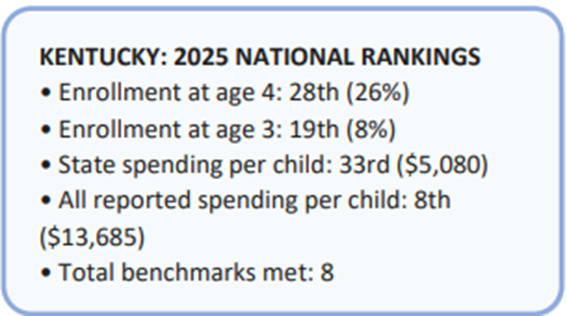
Kentucky’s funding picture is mixed. State spending per preschool child—about $5,080—ranks 33rd nationally. In addition, while 28 other states have increased per pupil spending for their state preschool programs recently, Kentucky’s public preschool state funding has remained flat for many years, which in 2026 equates to a 30% reduction in buying power when adjusted for inflation, a contributing factor to the Kentucky preschool program’s decreasing enrollment.
There is also good news. Kentucky’s Preschool Program meets 8 of NIEER’s 10 research-based quality benchmarks — comprehensive early learning and development standards, curriculum supports, teacher credentials and specialized training, class sizes and adult-child ratio, health screenings and support, and continuous quality improvement. Kentucky still misses the benchmark on teacher assistant qualifications and training. The state has resumed implementation of its revised ALL STARS Quality Rating and Improvement System, including classroom observations and data-driven improvement strategies, and is about to launch a study to make recommendations to modernize the system. Quality matters, and Kentucky has built strong foundations.
But quality alone cannot offset declining access. As NIEER’s researchers make clear, access without quality is insufficient—but quality without access leaves too many children behind.
Why This Matters for Kentucky’s Future
In Big Bold Future 2025, the Prichard Committee calls for Kentucky to:
- Expand access to high-quality early learning opportunities
- Strengthen alignment across early childhood, K–12, and postsecondary systems
- Address persistent inequities tied to income, geography, race, and disability
The NIEER data show why these recommendations are urgent. When fewer than one in three four-year-olds—and fewer than one in ten three-year-olds—can access state-funded preschool, gaps in readiness are inevitable. Those gaps show up later in third grade reading scores, middle school achievement, high school graduation rates, and ultimately workforce participation.
“The findings in the NIEER Yearbook align closely with the Prichard Committee’s long-standing message: early childhood education is not a side issue—it is the starting point for Kentucky’s entire education and workforce pipeline,” notes Brigitte Blom, President and CEO of the Prichard Committee. “Kentucky cannot afford a system where a child’s zip code or family income determines whether they arrive at kindergarten ready to learn.”
Learning From What Works
The 2025 Yearbook highlights Georgia’s Pre-K program as a national model: statewide access, strong state investment, and all ten quality benchmarks met. Georgia’s investment in their state preschool program in 2024-25 was over five times Kentucky’s, and their per child spending was $7,630 (19th in the nation), $2,550 more per child than Kentucky’s state funding. Georgia’s experience reinforces an essential lesson echoed in Big Bold Future: ambition and coordination matter.
Kentucky has already taken steps in that direction. In 2025, the Governor created the Team Kentucky Pre-K for All Advisory Committee, which brought together leaders from education, business, workforce development, and early care. The committee’s recommendations included a phased expansion of preschool access through leveraging partnerships between public and private preschool and Head Start, maintaining quality, and building a unified data system.
Another important step forward came during the 2026 legislative session, when policymakers enacted HB 6 and HJR 50, advancing consensus-driven reforms recommended by the Kentucky Collaborative on Child Care. These changes reflect a growing recognition that strengthening Kentucky’s early learning system requires more than isolated investments—it requires aligning and stabilizing the full birth-to-five ecosystem. By addressing funding stability, regulatory coherence, workforce supports, and quality improvement in the critical child care sector, these reforms will pave the way towards strengthening the connective tissue between programs and create a more seamless experience for families.
“A thriving, high-quality early care and education system is one in which private child care centers, family child care homes, state preschool, Head Start, maternal and child health agencies, Kentucky HANDS home visitation, and the Kentucky Early Intervention System work in concert to meet the unique needs of children,” Rina Gratz, Director of Early Childhood and Primary Education Policy and Practice for the Prichard Committee, contends. “This kind of unified approach is essential to ensuring that children are supported continuously—from infancy through preschool—and that educators and providers across sectors can sustain quality and expand access together.”
The challenge now is turning policy priorities into sustained and coordinated action.
A Big, Bold Next Step
The NIEER Yearbook does not argue that Kentucky should lower its standards to enroll more children. On the contrary, it reminds us that expansion must be paired with investment—in teachers, classrooms, data systems, and continuous improvement. Big Bold Future 2025 affirms that same principle.
Kentucky’s children—and its economy—benefit when we:
- Treat early education as essential infrastructure
- Ensure public investment matches the real cost of quality
- Build systems that support families, educators, and communities together
These are not abstract goals. They are practical steps grounded in evidence and aligned with Kentucky’s values.
The Bottom Line
The 2025 State of Preschool Yearbook should be a wake-up call, but also a call to action. Kentucky has strong programs, committed educators, and a clear vision for the future. What we need now is the will to align policy, funding, and leadership behind our youngest learners.
As Big Bold Future 2025 reminds us, Kentucky’s future is shaped long before a child enters third grade or chooses a career pathway. It begins in the earliest years—and the choices we make now will echo for decades to come.
The Prichard Committee will continue to advocate for policies that reflect that truth, because a big, bold future starts with giving every child a strong start.