

Susan Weston On 2026 Test Scores
Here comes my last big test score analysis as a Prichard Committee Senior Fellow, and I’m going to do this in my own clear voice, with five main points.
1. Most of what matters isn’t in this data.
Kentucky state testing doesn’t show anything about how well Kentucky students can:
- Evaluate new information and communicate it effectively
- Take on a problem, propose a solution, and check how well their proposal works
- Engage the arts
- Work in teams
- Participate in the civic life of a constitutional republic
House Bill 257 is a potent opportunity to move attention back to those other learning goals. HB 257 invites indicators that are designed and evaluated locally, allowing us to deepen attention to durable skills and the kinds of engaged, empowered work often described as vibrant learning. Those efforts look to me like a hugely important opening worthy of every community’s participation.

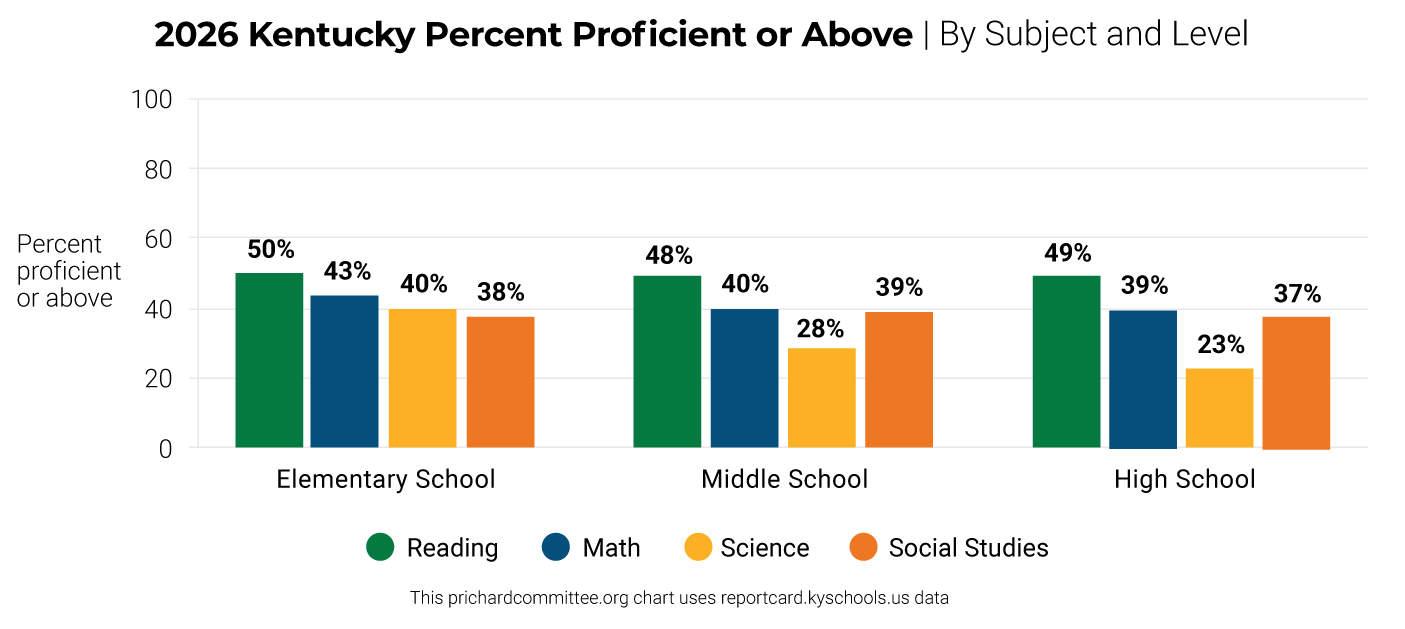
2. Based on this data, proficiency for all is still very far away
Kentucky entered 1992 talking about 100% proficiency by 2012, and we are a long way from that mark in 2026.
3. We’re making progress, but it’s mostly very slow
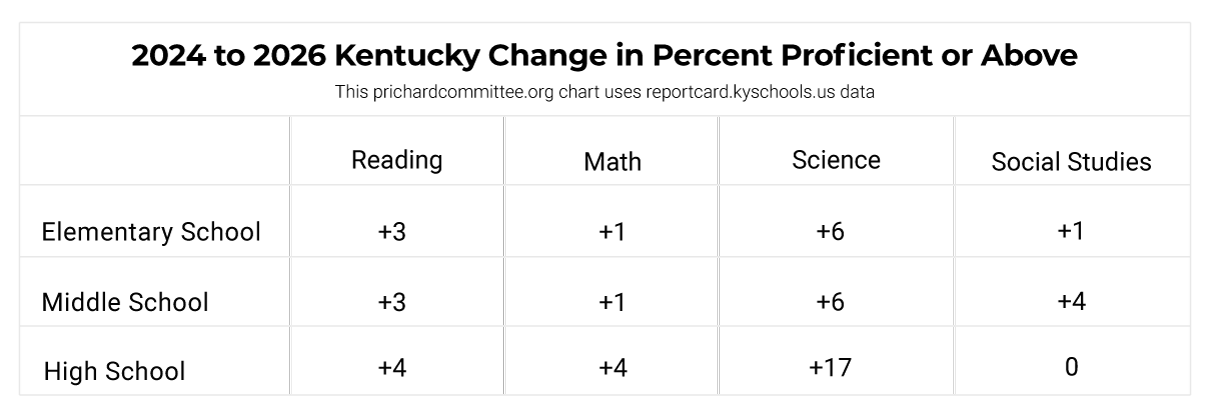
Here’s the pace of change over the last two years. Except for high school social studies, it’s all in the right direction. Except for science, it also isn’t at the speed Kentucky needs. (I want to learn more about the science growth!)
4. What is happening to Black students cannot be explained by talking about economic disadvantage.
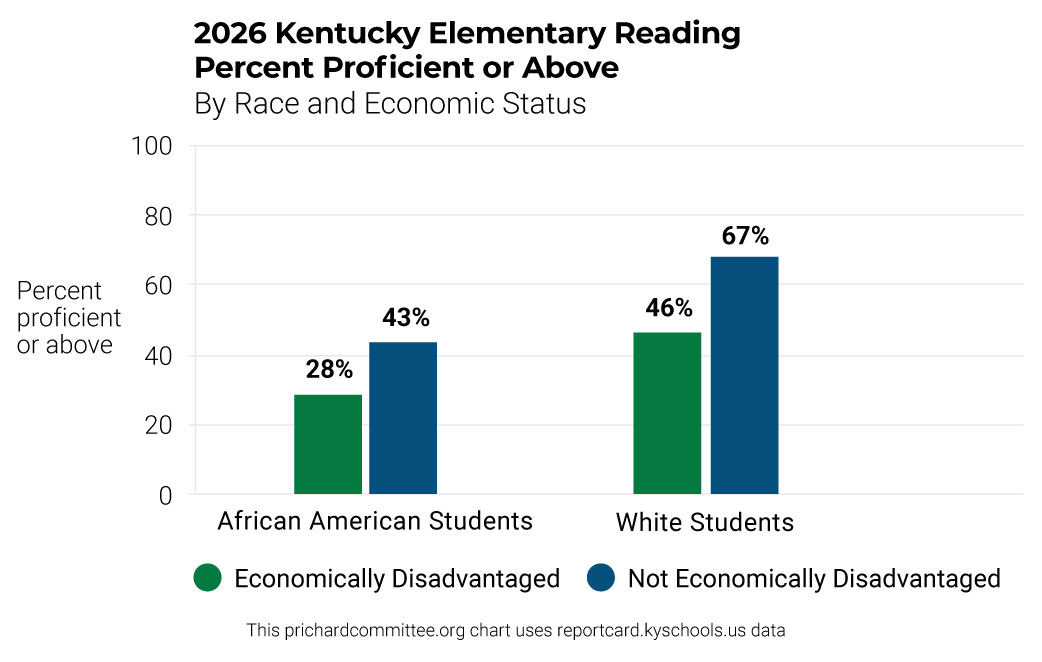
Disaggregated data has been part of my work every year since 1994, and I could spend the next nine weeks writing about nothing else. Instead, I’ll make one main point. Every year, someone pitches the idea that Black scores really just reflect less prosperous homes. Every year, the crosstab data bats down that idea. No, Kentucky, we cannot escape from race by talking about economics. We must become communities that ensure that Black children are safe, welcome, and empowered in our schools.
5. Real improvement lies on a clear, but challenging path
How, after all these years, can we create improvement big enough to create important upward mobility and substantial new strength and participation in our communities?
From all of us, it’s going to take commitment to learning and respect for teaching. The commitment to learning must build competence by protecting and engaging each and every student, including being frank with one another when the results aren’t good enough. The respect for teaching will need to show in working conditions and compensation as well as our words and behavior.
From state government, it will take strong funding, of course, and it will also take stable expectations. Changing accountability rules every year and academic standards over and over are making it impossible for educators to make plans, implement them, study results, and refine plans for next use. The policy churn needs to stop
From local communities, it will take a huge burst of new energy. We need results on these subjects and on big learning goals richer than we can show on state tests, which is again why vibrant learning and HB 257 implementation are so important.
I’m still here for the work even as I prepare to find new ways to make my contributions. For all my fellow Kentuckians, I hope you find good ways to contribute as well. Education is and will remain our best path to a larger life.