




The House Proposed Budget
House Bill 500, filed last Wednesday, is the first General Assembly step in setting the executive branch budget for the next two fiscal years. The current version includes concerning education cuts, but the House plans further discussions that will allow advocacy for restoring and even strengthening Kentucky’s investments.
Overall Reductions and Upcoming Discussions
As filed, HB 500 reduces General Fund spending to $14.9 billion for FY 2028, down from $15.2 million in the FY 2026 enacted budget. That 2% proposed decline includes a $75 million increase for the Department of Education, an $187 million cut to postsecondary education, $48 million in child care cuts, and cuts to most other cabinets and agencies.
HB 500 is not final, but instead is designed for further changes to be considered. Representative Petrie, chair of the House Appropriations and Revenue Committee, said in a January 27 media release that “This version represents a clear starting point and a clear direction. The next step lies with state agencies as they provide information and work with our budget review subcommittees to determine what, if any, additional funding is needed.”
Early Childhood
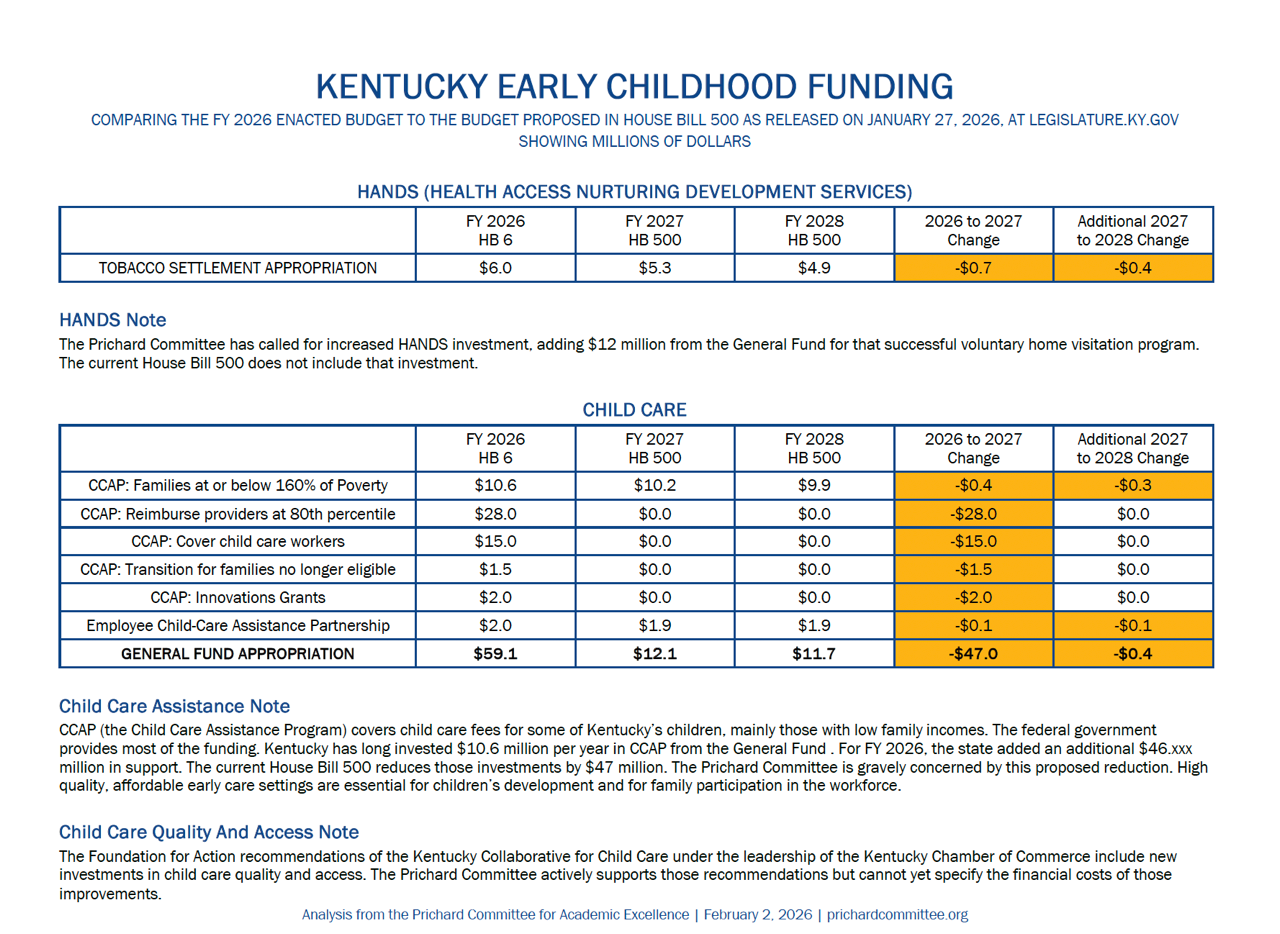
The current HB 500 calls for FY 2028 appropriations of
- $48 million less for child care than in the FY 2026 General Fund budget
- No increase for preschool
- No funding to strengthen HANDS, Kentucky’s voluntary home-visiting program for families with children under age three (A Prichard priority for increased General Fund resources)
- No funding to strengthen early literacy and numeracy skills (also a Prichard priority for General Fund investment)
Here’s a more detailed look at early childhood funding. (Click image to open full PDF view.)
P-12 Learning
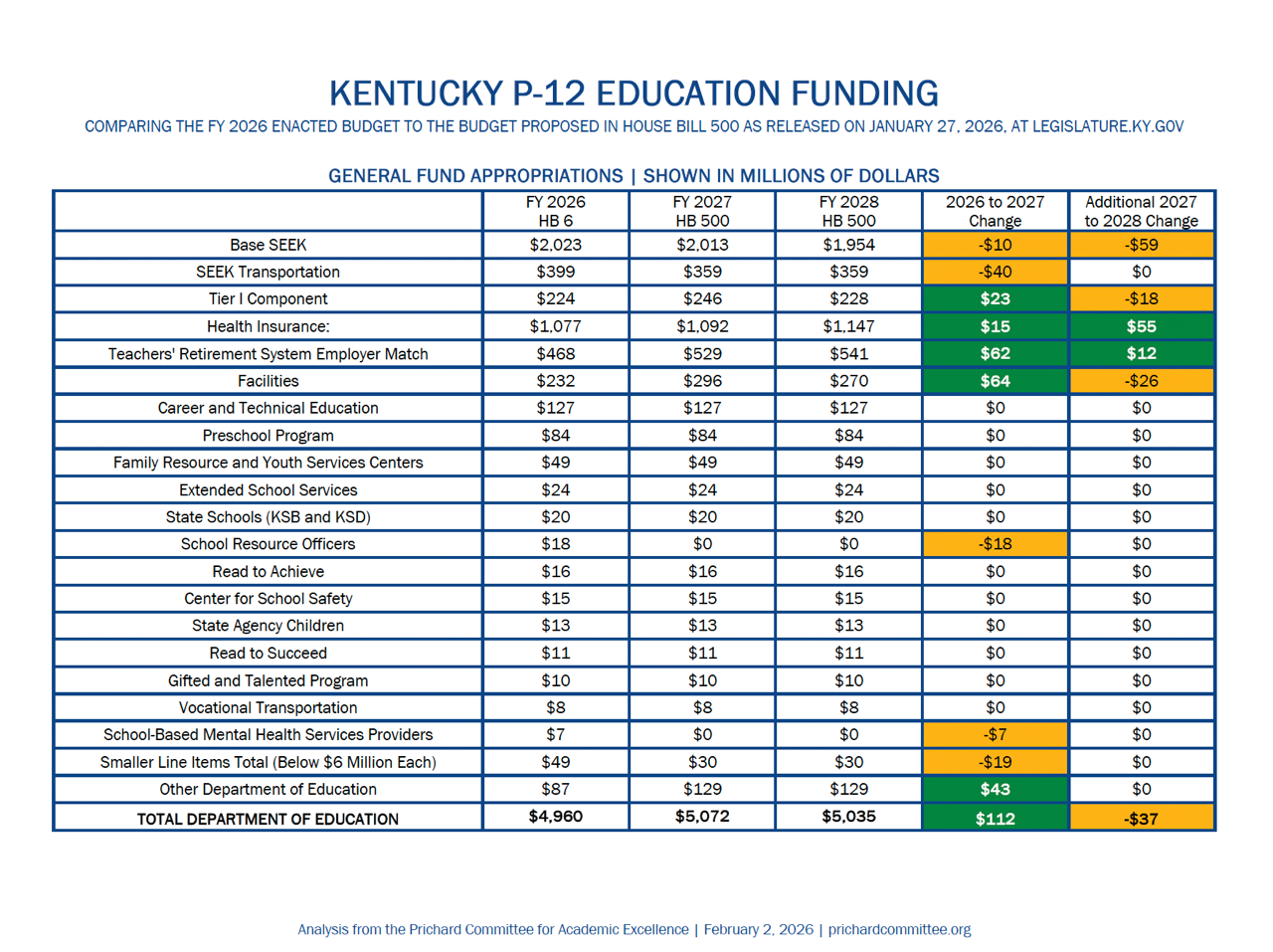
The current HB 500 adds $75 million to Kentucky Department of Education, comparing the FY 2028 appropriations to the FY 2026 enacted budget. KDE passes most of those dollars onto school districts and district employees.
Increases within that total include:
- $73 million more for the Teachers’ Retirement System employer match
- $70 million more for school employee health insurance
- $38 million more for facilities
- $5 million more for the Tier I component of the SEEK formula
- $42 million more for costs not itemized, including the Department’s staff and facilities and education technology and networking
Cuts within the total include:
- $69 less for base SEEK funding (maintaining the current $4,586 base guarantee per pupil, but assuming that local 30¢ contributions to the guarantee will rise as property assessments grow)
- $40 million less for SEEK transportation (moving Kentucky in the wrong direction from full transportation funding, a Prichard priority)
- $18 million less for school resource officers (but with a provision that the Department will reimburse districts for $20,000 per officer)
- $7 million less for school-based mental health services providers
- $19 million less for smaller initiatives of $6 million or less
Finally, the KDE budget includes no funding for another Prichard priorities:
- Guaranteed access to algebra I by 8th grade for students ready for that work
HB 500 also calls for additional FY 2028 changes (compared to FY 2026 appropriations) that affect elementary and secondary learning shown in other parts of the bill:
- $220 more directly to Teachers Retirement System
- No added funding for the Craft Academy for Excellence in Science and Mathematics and the Gatton Academy of Mathematics and Science in Kentucky
- $18 million less for the School Facilities Construction Fund
- $182,900 less for the Model Laboratory School
- $92,700 less for the Kentucky Center for Mathematics
Here’s a more detailed look at P-12 funding. (Click image to open full PDF view.)
Postsecondary Education
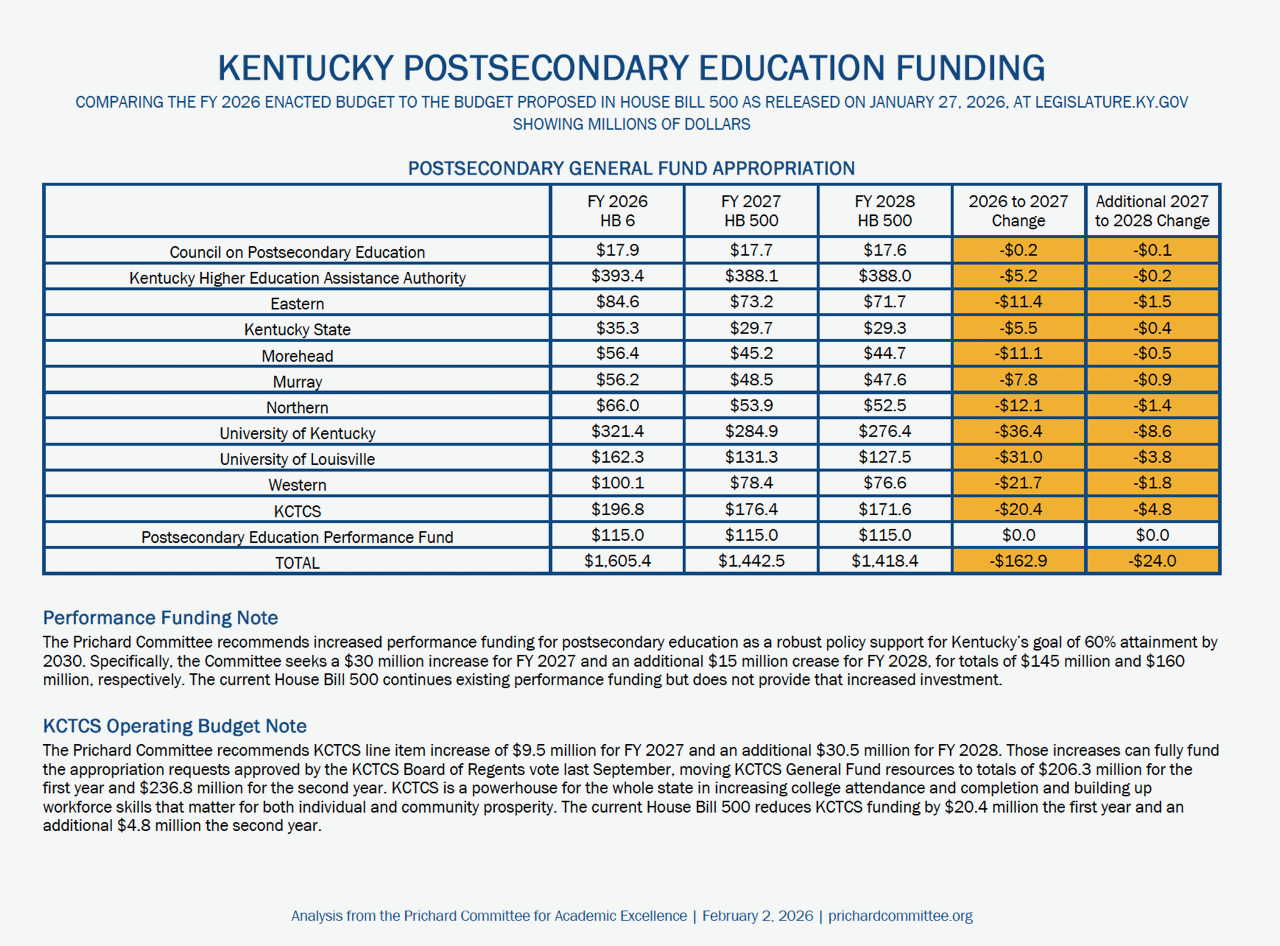
HB 500 calls for $187 million in cuts to postsecondary education, again comparing the FY 2028 dollars to the FY 2026 enacted budget.
Those cuts include:
- $45 million less for the University of Kentucky
- $35 million less for the University of Louisville
- $25 million less for KCTCS (a Prichard priority for increased investment)
- $24 million less for Western
- $13 million less for Eastern
- $13 million less for Northern
- $12 million less for Morehead
- $9 million less for Murray
- $6 million less for Kentucky State
- $5 million less for KHEAA financial aid (Including no increase for dual credit and work ready scholarships, a Prichard priority for increased investment)
- $291,000 less for Council on Postsecondary Education
Flat funding, with no cut or increase, is provided for:
- the Postsecondary Education Performance Fund (a Prichard priority for increased investment)
Here’s a more detailed look at postsecondary funding. (Click image to open full PDF view.)
Prichard Priorities for Upcoming Discussions
In the upcoming discussions called for by Chairman Petrie, the Prichard Committee will advocate actively for the key elements of its legislative agenda, including:
- HANDS (Health Access Nurturing Development Services, the voluntary home visitation program)
- Foundation for Action recommendations for child care access and quality
- Early literacy and numeracy
- Early access to algebra classes
- Durable skills
- School transportation funding
- Dual credit and work ready scholarships
- Postsecondary performance funding
- KCTCS
The Prichard Committee will also argue against selected HB 500 cuts, including:
- CCAP (the Child Care Assistance Program)
- School mental health providers
- Advanced Placement and International Baccalaureate fee help for low-income students
Finally, the Prichard Committee actively supports the Numeracy Counts investment in quality mathematics instruction. Kentucky has invested $5 million in each of the last two fiscal years under 2024’s House Bill 162, rather than the main House Bill 6 budget legislation. The current House Bill 500 does not include Numeracy Counts funding.
Kentucky consistently ranks near the bottom nationally in poverty and has never risen above sixth from the bottom. The state’s budget choices this year will shape Kentuckians’ opportunity for upward mobility for a generation, which is why it is crucial we get those investments right.