





Early Childhood and Primary Education in Kentucky’s 2026 Legislative Session: Strong Policy Progress, Fragile Systems and What Comes Next
For more than four decades, the Prichard Committee for Academic Excellence has championed a simple, evidence‑based belief: education is Kentucky’s strongest path to a larger life and lasting upward mobility. That belief guided our work throughout the 2026 Legislative Session, as lawmakers considered how early childhood and primary education can better support children, families, and the state’s workforce.
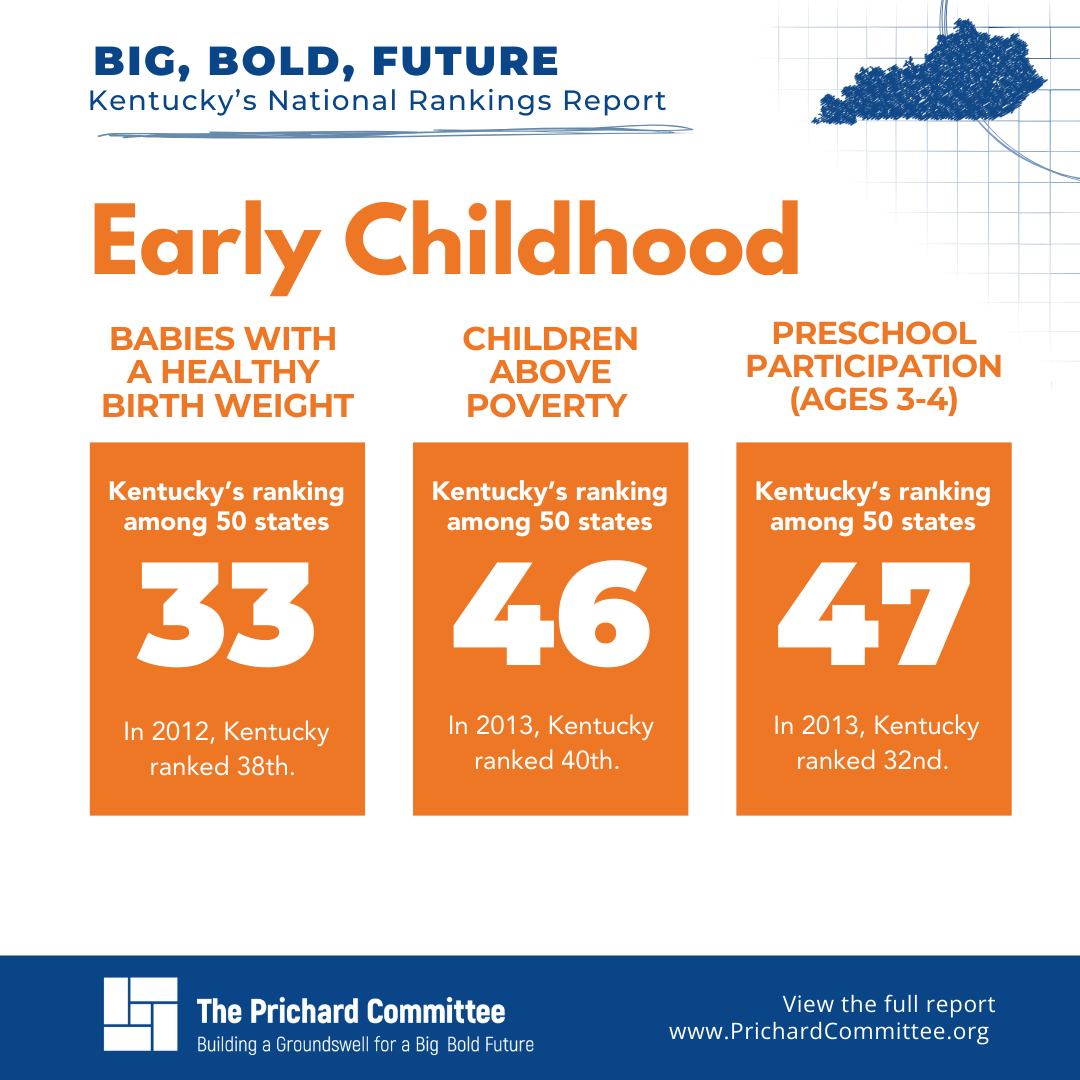
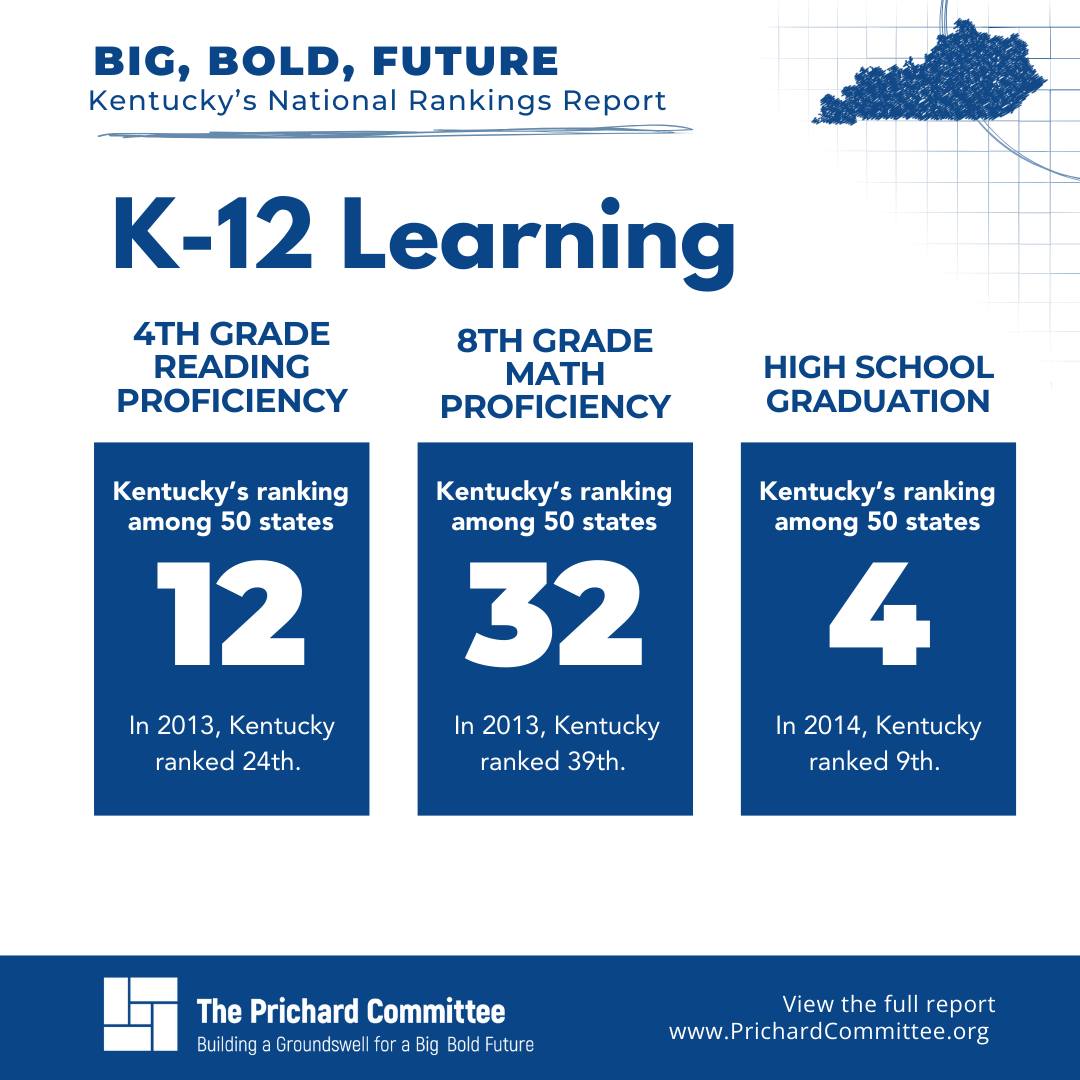
The urgency of this work is underscored by the Prichard Committee’s most recent Big Bold Future National Rankings report. While Kentucky ranks among the top five states in high school and two‑year postsecondary graduation, the Commonwealth continues to lag near the bottom nationally on the very indicators that shape children’s earliest years—ranking 47th in preschool participation, 46th in the share of children living above the poverty line, and 33rd in babies born at a healthy birth weight. These outcomes not only constrain individual opportunity but also limit the long‑term return on Kentucky’s K–12 and postsecondary systems.
Meaningful Early Childhood Policy Progress
The 2026 session delivered real policy gains, especially in child care. House Bill 6 (HB 6), sponsored by House Families and Children Chair Rep. Samara Heavrin, stands out as one of the most comprehensive set of consensus early childhood reforms Kentucky has enacted in years. The law modernizes the child care system by strengthening Kentucky All STARS, emphasizing research‑aligned quality standards, improving data transparency, and launching a structured, stakeholder‑driven modernization process.
HB 6 also expands access by allowing licensed child‑care microcenters, helping meet the needs of rural communities, families working non-traditional hours, and other underserved populations. The bill also paves the way for increasing child care access for military families. These changes align directly with the Prichard Committee’s priority to build local capacity and stabilize child‑care supply so families can work and communities can grow.
That momentum continued with House Joint Resolution 50, (Sponsor: Rep. S. Heavrin) which directs a comprehensive review of child care statutes and regulations with the goal of reducing unnecessary barriers while protecting child health and safety. Importantly, the resolution preserves child‑to‑teacher ratios, reflecting growing agreement that Kentucky can expand access without compromising quality.
The session also strengthened regulatory fairness and workforce stability. Provisions from Senate Bill 160, sponsored by Senate Families and Children Committee Chair Danny Carroll, incorporated into HB 6, improve the licensing system by pairing accountability with hands‑on technical assistance—especially for newly licensed providers. This approach helps prevent unnecessary closures, protects families’ access to care, and supports workforce participation across the state.
In the context of Kentucky’s national standing, these policy gains represent critical first steps. The Big Bold Future data show that Kentucky is not on pace to reach the top 20 states in preschool participation within the next decade without accelerated action. Structural improvements enacted in 2026—particularly those expanding child care supply, improving quality measurement, and reducing barriers for new providers—align directly with the state’s most urgent early childhood gaps, but their success will ultimately depend on sustained investment and scale.
Strengthening Primary Education
Lawmakers also took steps to improve kindergarten readiness and instructional quality. Senate Bill 191, (Sponsor: Sen. D. Carroll) added to HB 6, establishes a Kindergarten Readiness Performance‑Based Child Care Incentive Pilot running from 2027 to 2029. The pilot will test whether well‑designed incentives can improve readiness outcomes without creating unintended pressure on educators or families. The Prichard Committee supports the pilot’s focus on evaluation, safeguards, and collaboration with early childhood experts.
Early literacy saw a major advance with House Bill 253, sponsored by Representative James Tipton, which requires science‑of‑reading professional learning for early childhood through grade five educators and strengthens supports for students with dyslexia. By grounding instruction in strong evidence and starting early, the General Assembly reinforced the essential role early educators play in long‑term student success throughout the educational pipeline.
Budget Outcomes: Holding the Line
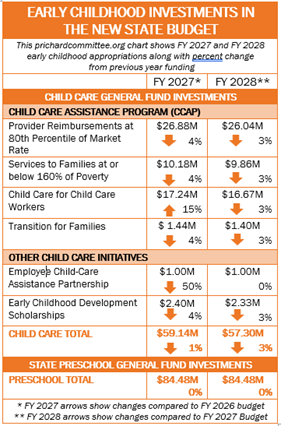
While policy progress was strong, budget outcomes were mixed. The final state budget, House Bill 500, deserves recognition for preserving several major investments, including full day kindergarten, continued support for Read to Succeed, and $56 million in Child Care Assistance Program (CCAP) initiatives, a testament to persistent consensus advocacy on behalf of the child care community, growing bipartisan support for early care and education among lawmakers, and a signal that a thriving child care sector is critical to the workforce of today and tomorrow. The budget applied 4% (FY 27) and 3% (FY 28) cuts for many of the child care initiatives while adding funds for a study and a pilot program. Funding for CCAP for child care workers increased by 15% in FY 27 as the Employee Child Care Assistance Partnership was cut in half. Other early childhood initiatives, however, saw much greater cuts of 11% in FY 27 and 8% in FY 28: the HANDS home‑visiting program, KY All STARS, the Early Childhood Advisory Council, and early childhood health initiatives like Healthy Start, substance abuse prevention, oral and mental health and lung cancer screening. These cuts affected the programs funded with dollars from the Tobacco Master Settlement Agreement.
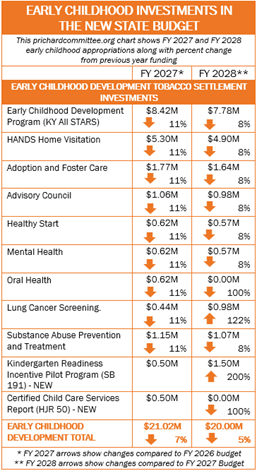
The successful defense of $2.5 million annually for Dolly Parton’s Imagination Library of Kentucky and the existing 50:50 cost model between state and local funds followed strong statewide mobilization and now protects access for families in every county—one of the session’s clearest grassroots advocacy wins for young children.
At the same time, the state budget for early learning reflected maintenance rather than momentum, falling short of providing the scale of funding needed to fully stabilize the entire early education ecosystem. While 28 other states have increased per pupil spending for their state preschool programs recently, Kentucky’s public preschool funding remained flat (which equates to a 30% reduction when adjusted for inflation). The Kentucky Center for Mathematics and the Statewide Reading Research Center retained level funding, but Numeracy Counts received no line-item appropriation. The Big Bold Future National Rankings reinforce this concern: as of the most recent data, Kentucky ranks 32nd National Assessment of Educational Progress (NAEP) in 8th‑grade mathematics, placing the state well off pace for long‑term competitiveness. Research consistently shows that later math outcomes are shaped by learning trajectories well before kindergarten. Without stronger early numeracy investments and professional learning, Kentucky risks perpetuating a pattern of slow, incremental improvement rather than the bold gains required to change its national position.
The state budget also does not extend the same evidence-based professional learning opportunities provided through Numeracy Counts and Read to Succeed into early learning setting despite clear evidence that early literacy and numeracy training and coaching support deliver strong returns.
A last-minute provision in HB 500 Free Conference Committee Report clawed back $6.5 million , returning it to the Tobacco Settlement Agreement Fund. While the budget redirected $2.5M of that to early childhood initiatives, $4M was funneled to cancer research. ECDF carryforward has historically kept early‑childhood systems running when federal funds were delayed or cut. It has paid awards, stabilized providers, supported workforce development, and prevented service disruptions. The loss of that carryforward places discretionary, quality‑focused, and coordination‑heavy programs—especially All STARS, regional councils, and workforce supports—at risk. The Big Bold Future data show that Kentucky’s weakest rankings cluster in early life outcomes—areas that depend most heavily on cross‑agency coordination, local innovation, and sustained infrastructure support. Undermining those system‑building tools increases the risk that Kentucky’s early childhood indicators will remain among the nation’s lowest, even as later‑grade outcomes continue to improve.
Progress, Gaps, and a Missed Opportunity
Taken together, the 2026 session delivered important reforms and maintained existing investment levels, but left core Prichard Committee early childhood priorities only partially met. Policymakers advanced smart policy frameworks for quality, access, and accountability, but long‑term investments remain unfinished work.
The failure to pass House Concurrent Resolution 108, sponsored by Representative Mike Clines, underscored this challenge. HCR 108 would have created a task force to study how to better align governance across child care, early learning, preschool, and K–12 education. The Prichard Committee is hopeful that mobilization in the interim can turn this miss into an important opportunity to pave the way for a more coherent early care and education system grounded in evidence and continuity. National trends highlighted in the Big Bold Future report show that states demonstrating the strongest early childhood gains are those aligning child care, preschool, and early elementary governance around shared outcomes and public accountability to Kentucky’s families and taxpayers. A mechanism to study and pursue that alignment can move Kentucky from the bottom tier of national early childhood rankings and maximize access and opportunity for a strong start for all Kentucky children.
Looking Ahead
Kentucky made meaningful policy progress in 2026 and held steady in investments in child care, strengthening the groundwork for future gains—but progress without additional investment is not enough. Delivering the dramatically better outcomes our children deserve, and the fuller lives those outcomes make possible, demands sustained, bold investment across the entire early care and education ecosystem—something this new biennial state budget fails to provide.
The Big Bold Future National Rankings make clear that Kentucky’s challenge is not a lack of potential, but a mismatch between ambition and investment in the earliest years. The Commonwealth has demonstrated it can climb into the top tier nationally when it commits to sustained, evidence‑based action. Applying that same resolve to early care and education investment and ramping up vigilance and partnership with public officials in implementing policies effectively are essential if Kentucky is to move from incremental progress to a truly big, bold future for all children and families.