



Assessment, Accountability & Learning Changes for K-12 Education

Assessment and accountability changes will be coming quickly to our public schools. House Bill 257 (HB 257) approved provisions that offer:
- Policy progress building on the many discussions and design efforts that have emerged from the statewide Kentucky United We Learn work
- Big challenges for state-level regulations, guidance and support
- Even bigger challenges for local decisions and community mobilization
If Kentuckians show up together to implement these changes well, Kentucky can take a major step forward for vibrant learning, engaged teaching and our Big Bold Future.
(In this post, we’ve limited our use of specialized education vocabulary, and we’ve also added a small glossary at the end of the post for four terms that are just inescapable: accountability, assessment, indicators, and measures.)
Writing Across the Curriculum (without State Assessments)
Under HB 257, Kentucky will cancel statewide writing assessments (both on-demand and mechanics). Instead, local school districts will create and implement writing programs that:
- “Include disciplinary-specific writing across the curriculum” and
- “Incorporate a variety of language resources, technological tools, and multiple opportunities for students to develop complex communication skills for a variety of purposes.”
The “across the curriculum” approach is a powerful expectation. When writing is learned mainly in English or language arts classes, students miss opportunities to explain scientific concepts and evidence using technical writing style expected there. Similarly, students in English classes may not get the sufficient practice in evaluating sources and developing arguments to meet the expectations of history, civics, and other social studies fields. That’s why curriculum-wide writing can make a big difference in students’ readiness for higher education, careers and participation in their communities.
Statewide academic standards already call for students to take on the writing that matters in each discipline. Under this new approach, the Kentucky Department of Education will also provide guidelines and professional learning opportunities to support local efforts.
Superintendents will each define their districts’ writing programs by adopting policies. While the new legislation does not give school boards, school councils, educators, students, families and other residents an official role in deciding this policy, the decisions will succeed or fail based on how well they are supported by community understanding, buy-in and active support.
Allowing Local Indicators of Quality and Promoting Vibrant Learning
HB 257 also invites districts to create “locally developed indicators” and report those results to their communities. Since formal testing checks only a fraction of what students should know and be able to do, this is a powerful opportunity to add broader, deeper approaches.
For districts that choose to participate, the new law specifies that the local indicators will:
- Allow all students to demonstrate their ability to apply grade-appropriate, standards-driven knowledge, content and skills in real-world applications
- Include participation in vibrant learning experiences (see inset box)
- Be aligned with Kentucky’s academic standards
- Fit with KBE regulations
- Be shared in published displays that include breakouts of results for student groups.
One-time funding, up to $15,000 per district, will be available to offset some of the costs of these efforts.
What is Vibrant Learning?
HB 257 defines vibrant learning as:
“An educational experience that is:
- Characterized by student agency and the application of knowledge and skills aligned with the academic standards established in Section 2 of this Act;
- Developed in partnership with students’ families, local communities, and the local workforce; and
- Demonstrated through personalized projects, outputs, experiences, or other produced results reflecting each individual student’s academic and career interests.”
Vibrant learning emerged as a central element of what Kentuckians want for students and schools across the many months of work that have gone into the Kentucky United We Learn project.
HB 257 assigns these local indicator choices to “districts.” That leaves room for varied procedural approaches, but collaboration will be essential. This sort of innovation can only make a lasting difference if the work is designed with broad support both from those with top-level formal authority and from the wider community.
Changing Data Communities Receive
Published data on teaching and learning is a resource for community learning and action. Accordingly, it always matters when Kentucky changes the data that will be included in Kentucky School Report Card. Data will be added, some will be subtracted, and college admissions testing may (or may not) change again by next year.
GROWTH, ENGAGEMENT & TARGETED QUALITY ADDED
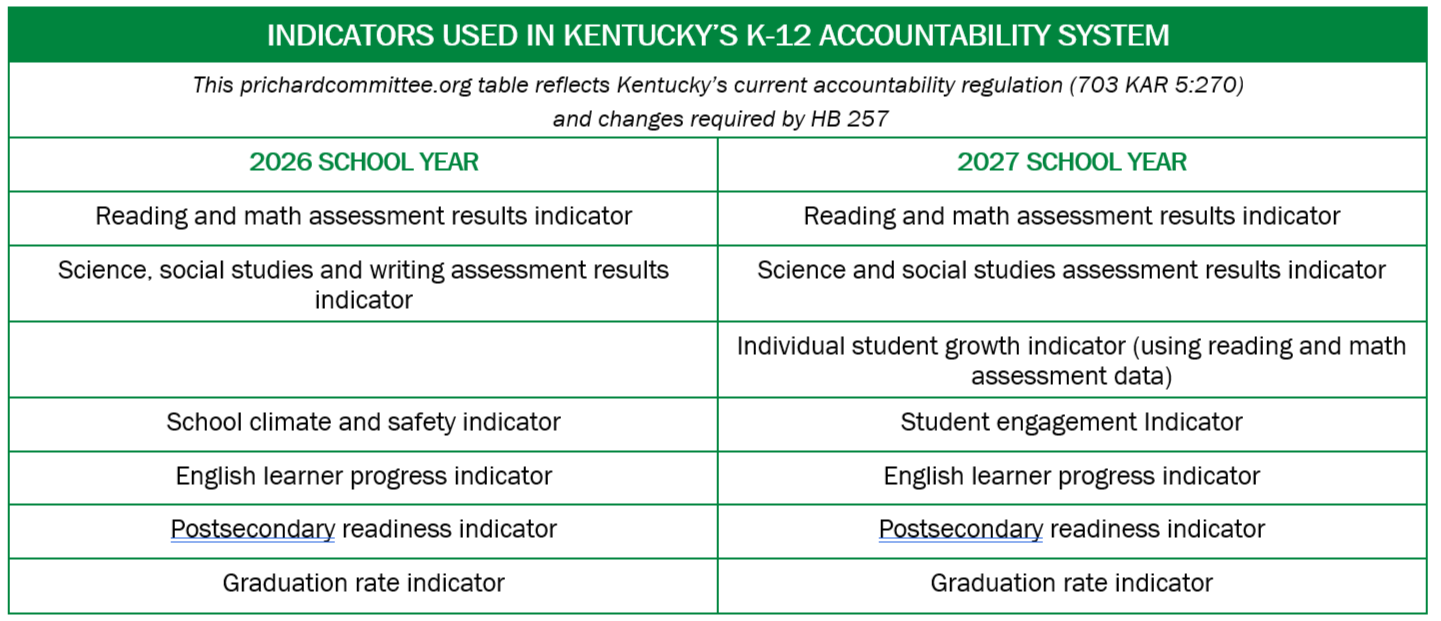
Two new indicators will be used in 2027 school accountability:
- Individual student growth will summarize reading and mathematics progress.
- Student engagement will reflect chronic absenteeism, meaning students who miss 10% or more of yearly school time.
A third new indicator, targeted quality will be added to school accountability in 2030, measuring change in
- percent of teachers with Rank II or National Board certification
- percent of grade eight students who have earned at least one high school credit
- percent of graduating students who complete the FAFSA (or file a parent-signed opt-out form)
Before 2030, that targeted data will be available in the Kentucky School Report Card, published for community consideration, but not used for accountability color codes and other decisions.
CLIMATE SURVEY, WRITING & COLORS FOR CHANGE REMOVED
The school safety and climate indicator will be deleted. That’s the indicator that has used survey data in recent years.
As noted above, statewide writing assessment will end. Those scores will no longer be included in the Kentucky School Report Card, and they will no longer be a measure used to calculate an assessment indicator.
Color codes for change will also be gone. In recent years, Kentucky’s color-coding system that “differentiates” schools has offered separate color dials for each school’s “status” (current data) and “change” (development since last year’s data) on each indicator. The status versions will continue, but the change markers will no longer be reported.
COLLEGE ADMISSIONS TEST CHANGING?
In recent months, it looked like the SAT would replace ACT as the college admissions test taken by all public 11th grade students. A four-year contract has been signed to make that swap, but on the last day of the General Assembly, SB 179 was amended to include a provision saying:
The Kentucky Department of Education shall initiate a new competitive procurement process and shall award a contract only to a vendor or vendors whose assessment product satisfies all applicable state and federal statutory requirements for accountability and assessment purposes to be in place for the 2026-2027 school year.
Does that signal a return to ACT? It looks like there may be room for legal debate, and since a contract is in place, there may also be litigation, so the right answer is “Maybe.”
The Work Ahead
State education officials will play important roles in these changes: supporting the writing work, regulating and supporting local indicators and vibrant learning, adding new state indicators, and redoing the college admissions test choice.
The local work, though, is striking in its scale and ambition. Accountability changes only matter if they change classroom practice and student outcomes: that part is always true. This time, the local work is even larger: the full creation of new writing programs, decisions on if and how to build locally developed indicators, fresh efforts to create vibrant learning, new analysis of data and new decisions on which next steps to take in response.
Kentucky is placing a mighty bet on local capacity. The bet will pay off wherever communities pull together to build better learning and better futures. Engagement will be a truly essential factor everywhere. Seeing that clearly, let’s get to work!
Added Note: Some Key Definitions
As promised, here’s a very short glossary of terms that are in near-constant use in Kentucky K-12 education and especially in making state education policy and regulations:
- Accountability is used here to mean education policies that hold schools and districts accountable for student outcomes. It especially means Kentucky’s method of reporting on school results using color codes from red to blue to show weakest to strongest results in particular kinds of data and Kentucky’s formula for identifying schools for state intervention and support based on low results.
- Assessment is used here to mean activities that gather data on students that can be used to plan next steps in student learning, to report to communities on school results, and to make accountability decisions.
- Indicators are the main way results are reported in Kentucky accountability, usually combining data from several assessments and/or other ways of measuring outcomes. Each one is calculated as number and then used to assign each school and district a color code for each indicator and for the combined results of all the indicators. The table below shows the indicators being used for the 2026 school year and the changed list for 2027.
- Measures are specific data sources, which can include assessments, attendance data, graduation data, and other kinds of information. Most of the indicators below are calculated by combining several measures.