



Postsecondary Action in the 2026 General Assembly

Postsecondary Action in the 2026 General Assembly
For Kentucky postsecondary education, the 2026 General Assembly:
- Strengthened and simplified the undergraduate admission process
- Added a new polytechnic mission for Kentucky State University
- Reduced access to AP (Advanced Placement) tests while improving dual credit opportunities
- Missed opportunities to strengthen performance funding and KCTCS (the Kentucky Community and Technical College System)
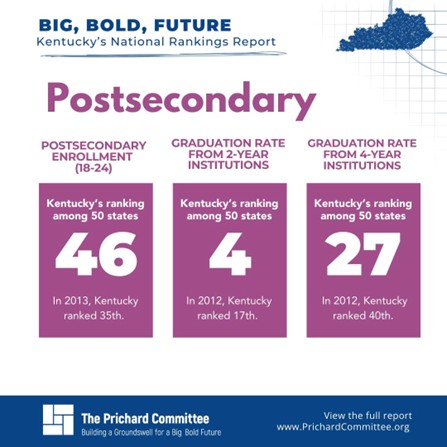
Both the opportunities that were taken and those that were missed will matter for Kentucky’s Big Bold Future, including our ability to raise our education and quality of life rankings among the 50 states, and our statewide work to build enrollment, attainment, economic mobility and a stronger Commonwealth.
Proactive College Admissions
By 2028, Kentucky high school students will be able to sign up for:
- A common online application for all Kentucky public postsecondary institutions
- Notification when they have met minimum qualifications for admission to each of those schools
Those innovations are required by House Bill 307 which also requires active high school efforts to promote participation in the system and annual reporting to the legislature on how widely the system is being used. This change looks like a sturdy step forward on making higher education accessible. Rep. James Tipton sponsored House Bill 307 and played a key role in enacting this valuable innovation. (To learn more, click on the bill number above and then click on current/final to see the full bill text.)
A Polytechnic Kentucky State
Senate Bill 185 amended and approved on the last day of the session, provides that:
“Kentucky State University, recognized as an 1890 land-grant university that is Kentucky’s only public Historically Black College or University (HBCU), shall be a four year residential polytechnic institution that focuses on highly technical, industry-based applied learning and offers liberal studies and polytechnic programs that are aligned with the workforce needs of the Commonwealth and consistent with the historical mission of an HBCU.”

That move to the polytechnic role will involve reducing the liberal arts programs offered at KSU, possibly accompanied by faculty reductions in those fields. The University will also operate under tight financial oversight for up to the next five years. Senate Bill 185 was sponsored by Sen. Chris McDaniel, and the final amendments were developed with important leadership from Rep. Joshua Watkins.
Overall, the polytechnic approach can create fresh opportunities to equip Kentuckians to make innovative, economically valuable contributions to the Commonwealth, while requiring creative new approaches to continuing KSU’s proud heritage.
Growing and Shrinking Advanced Coursework
The new state budget, House Bill 500 will add $6.3 million per year for dual credit scholarships, drawn from past years’ Lottery earnings. Those dollars are on top of $21.1 million from the General Fund. Those dollars expand opportunity for students who enroll in college-level classes while still in high school.
The new state budget will also reduce annual funding for AP (Advanced Placement) test fees, another way that students can earn college credit in high school. Past budgets have provided two separate line items for those fees. In House Bill 500, one line item disappeared: students will no longer have access to $2.6 million a year in help available to all students on a first-come, first-served basis. The other line item was reduced: past years have offered $1 million in help specifically for students with low family incomes, but the new budget offers reduced that funding to $960,000 for FY 2027 and $930,000 for FY 2028.
Reducing Overall Funding
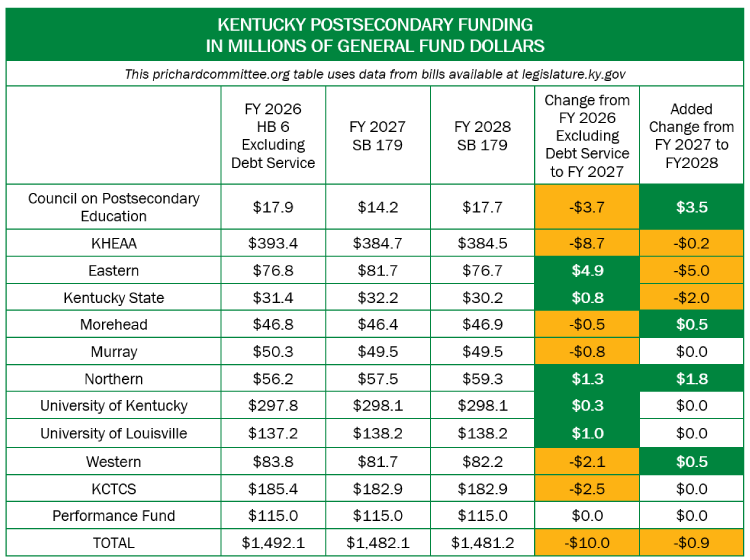
House Bill 500 was approved on April 1, reducing General fund resources by about $26 million in FY 2027 and another $16 million in FY 2028. On April 15, just hours from final adjournment, Senate Bill 197changed that: the postsecondary reductions will be only $10 million the first year plus an added $1 million reduction the second year. Those are small cuts, but they still raise concerns because costs are rising quickly and because Kentucky is aiming high: reduced resources will make it harder to reach the Commonwealth’s ambitious goal of for 60% of adults 24 to 64 to have a postsecondary credential by 2030. [For detail on these comparisons, see the note at the bottom of this post.]
KCTCS saw its General Fund appropriation drop from $185.4 million in FY 2026 to $182.9 million in FY 2027. Cuts to KCTCS are a particular concern, because of that system’s important record of growing enrollment and completion, and its truly essential role in Kentucky work to increase the number of adults with postsecondary attainment of degrees and credentials. Plus, recent national comparisons show that KCTCS is receiving far less public support per student than the national average. The Prichard Committee had identified KCTCS as particularly in need of rising support.
Performance funding was unchanged: $115 million in FY 2026 and $115 million in FY 2027. The Prichard Committee supported increasing those dollars as further support to increasing attainment and upward mobility.
The Value of On-Ramps
Accessible higher education is how Kentucky can build a skilled workforce for the modern world. It’s the on-ramp to economic mobility for individuals and prosperity for the Commonwealth as a whole. We need steady growth in undergraduate enrollment and completion. For the 2026 legislative session, the admissions changes and dual credit funding are valuable new investments, and the KSU changes have important potential to strengthen our workforce. At the same moment, the AP cuts, KCTCS cuts, and flatline performance funding are weaker than the Commonwealth needs for future growth.
Added Note on Budget Comparisons
In past budgets, each university and KCTCS received General Fund dollars to make debt service payments. In the newly adopted budget, the Finance Cabinet is responsible for those payments. To respect that change, the reporting above compares FY 2027 and FY 2028 funding to the FY 2026 appropriations excluding the debt service amounts. Those amounts are shown in the table below.