




Toward a More Meaningful High School Diploma: The 2026 Legislative Session Progress, Gaps and What Comes Next

Toward a More Meaningful High School Diploma: The 2026 Legislative Session Progress, Gaps and What Comes Next
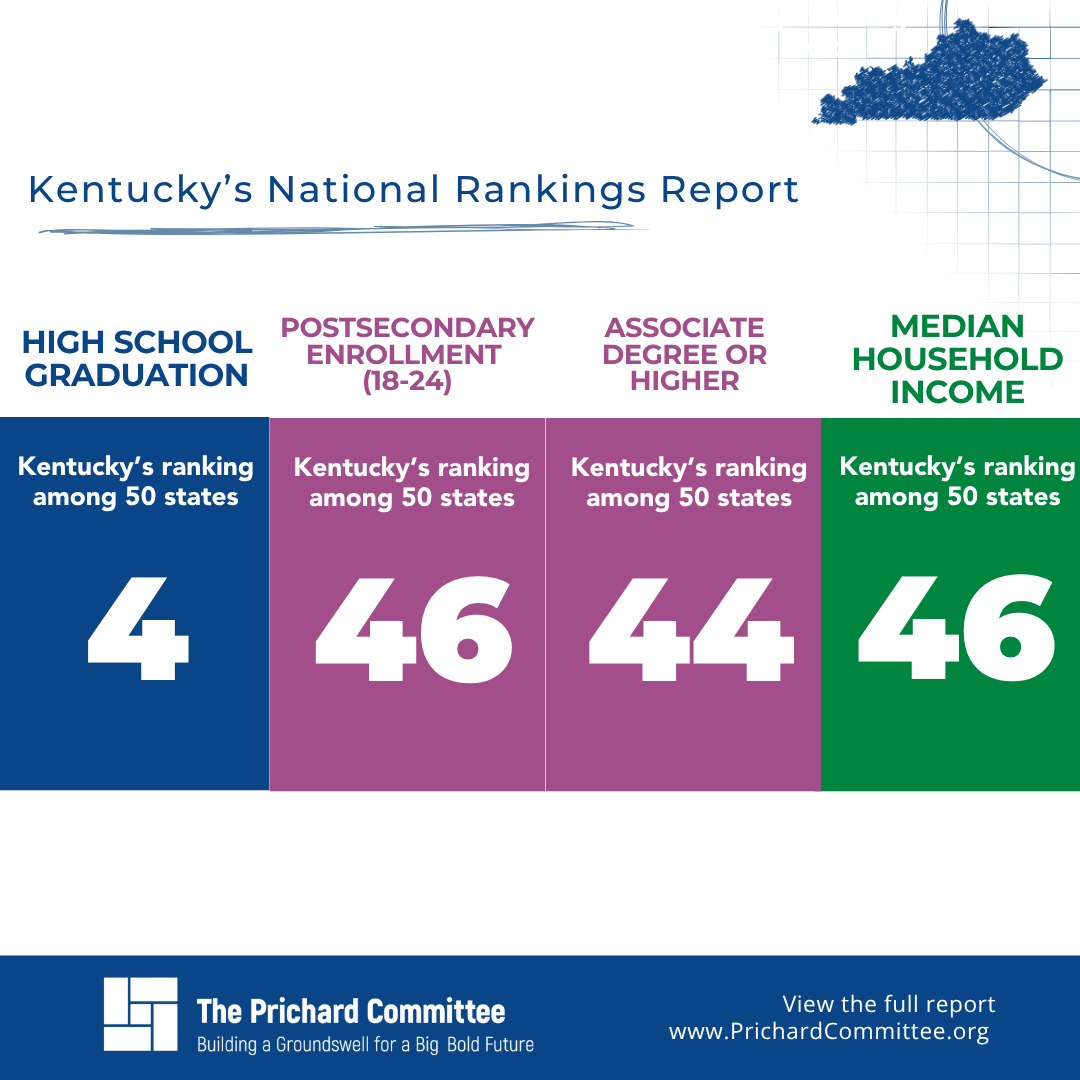
Kentucky ranks 4th in the nation for public high school graduation – yet only 53% of all Kentucky high school graduates pursue postsecondary education, approximately 1 in 3 leave high school proficient in core academics, and just 12% of Kentucky employers are strongly confident in recent graduates’ workforce readiness, according to a recent Prichard Committee statewide employer survey. Closing that gap – between earning a high school diploma and being ready for what comes next – is the work of the Prichard Committee’s Meaningful Diploma initiative, and it shaped our engagement this legislative session.
For Kentucky’s meaningful diploma agenda, the 2026 General Assembly:
- Advanced policy frameworks for a reimagined assessment and accountability system, principal leadership, and postsecondary awareness and access
- Preserved the opportunity for local voices to impact education, as well as the foundational funding that innovation depends on
- Fell short on the investments that turn policy frameworks into student outcomes – particularly in middle school math and dual credit
Meaningful Policy Progress
House Bill 257 (click current/final for full text), sponsored by Rep. J.T. Payne, modernizes Kentucky’s K–12 assessment and accountability system and creates space for local indicators that recognize the durable skills, vibrant learning opportunities and other quality measures communities, families, employers and postsecondary institutions value. The bill also adds three new targeted quality measures to the school report card – teacher quality (Rank II+ or National Board Certification), 8th graders earning high school credit, and FAFSA completion. Beginning July 1, 2030, the bill shifts them from the report card into the state accountability weighting formula at no less than 5% cumulative weight. Provisions from House Bill 789, championed by Rep. Robert Duvall and Chairman Scott Lewis, authorize a comprehensive study of middle school math access and outcomes. Algebra I by 8th grade is one of the clearest early-momentum signals in the Meaningful Diploma framework – a powerful predictor of advanced coursework, dual credit and postsecondary STEM pathways. Getting that gateway right is foundational to making diplomas mean more. HB 257 also enacts significant changes to K-12 assessment and accountability, which we will address in a separate post.
Senate Bill 4, sponsored by Sen. Stephen West, advances more systematic preparation and support for school principals by creating a leadership development practicum for new principals. Every meaningful diploma runs through a classroom led by a strong teacher – and every strong teacher benefits from a principal equipped to build the conditions for rigorous, student-centered learning. SB 4 strengthens that pipeline.
House Bill 727, sponsored by Rep. Steve Riley, makes several practical changes that support Kentucky’s school workforce and district operations. The bill directs the Education Professional Standards Board to replace the current educator placement system with a statewide job portal and authorizes five-year certificates for eligible retired teachers returning to the classroom — meaningful steps on the teacher shortage that remains a bedrock challenge for Kentucky schools. HB 727 also addresses maximum class sizes and caseloads for exceptional children and youth; aligns the non-voting student and teacher representatives on the Kentucky Board of Education to Supreme Court districts; adds ethics, open records, open meetings, and finance training for school board members; and allows districts to request SEEK funding adjustments when property assessment revisions shift the net general fund by 1% or more.
Senate Bill 263, also sponsored by Sen. West, expands work from last year’s session and creates a Schools of Innovation pilot program, giving districts flexibility to design rigorous pathways and learning environments that move a diploma beyond seat time alone into a true signal of readiness. Place-based innovation is a core principle of the Meaningful Diploma framework, and SB 263 gives it room to grow. HB 900 provides financial backing for these efforts: $2.5 million in FY 2027 and $5 million in FY 2028 from the Budget Reserve Trust Fund.
The failure of Senate Bill 152 preserved local voice in school governance by keeping school-based decision-making councils intact – the community-level structures that enable hyper-local responses from teachers and parents.
Strengthening the Bridge to College and Career House Bill 307, sponsored by Rep. James Tipton, establishes a proactive postsecondary admissions process, connecting more Kentucky students to college opportunities earlier and more intentionally. The program will use data (pulled from Kentucky’s robust state longitudinal data system – KYSTATS) to notify high school juniors of the Kentucky public colleges where they meet minimum admissions criteria. This is a practical response to the 53.3% postsecondary pursuing (college-going) rate – a way to reach students who may never have initiated an application on their own.
Senate Bill 249, sponsored by Sen. Phillip Wheeler, aligns Kentucky with the new federal Workforce Pell Grant program, positioning the state to support short-term credentials of value. As federal definitions finalize, Kentucky students and workers will access funding for training that leads to real wages – and Career and Technical Education (CTE) and career-aligned high school pathways will benefit from the rollout.
House Bill 562, sponsored by Rep. Timmy Truett, creates an alternate high school diploma pathway for students with disabilities who take alternate assessments – ensuring more Kentucky students graduate with a credential that recognizes their learning and opens appropriate postsecondary and workforce opportunities. This diploma will be recognized as a valid high school credential, helping students more clearly signal their readiness.
Budget Outcomes: Holding the Line
The enacted budget preserves the core K–12 investment structure. Base SEEK funding, the state’s primary K-12 per-pupil funding formula, increases nearly 4% over the biennium, with added Tier I support for districts with lower local revenue capacity – tangible gains that help keep classrooms staffed and operating.
But the budget tells a familiar story of maintenance rather than momentum. Funding for AP exam fees on a first-come, first-served basis was eliminated – a $2.6 million cut and a troubling reversal at a time when Kentucky should be widening access and reducing barriers to advanced coursework, not rationing it. The budget does still provide approximately $1 million to cover AP fees for students with low family incomes. Early postsecondary momentum is one of the clearest predictors of postsecondary persistence and completion.
SEEK transportation also remains underfunded, pushing costs onto local budgets. And even the SEEK increase is too small to restore the buying power SEEK offered a decade ago.
Dual credit programming continues to operate without the major expanded investment it needs. Dual credit scholarships will receive an extra $6.3 million per year from past years’ Lottery revenues, but that does not come close to the $33 million increase the Prichard Committee supported. Quality dual credit delivers postsecondary credit and accelerates credential completion, yet rising costs are increasingly absorbed by districts and families. A serious Kentucky strategy for increasing postsecondary attainment runs through robust, rigorous and well-funded dual credit.
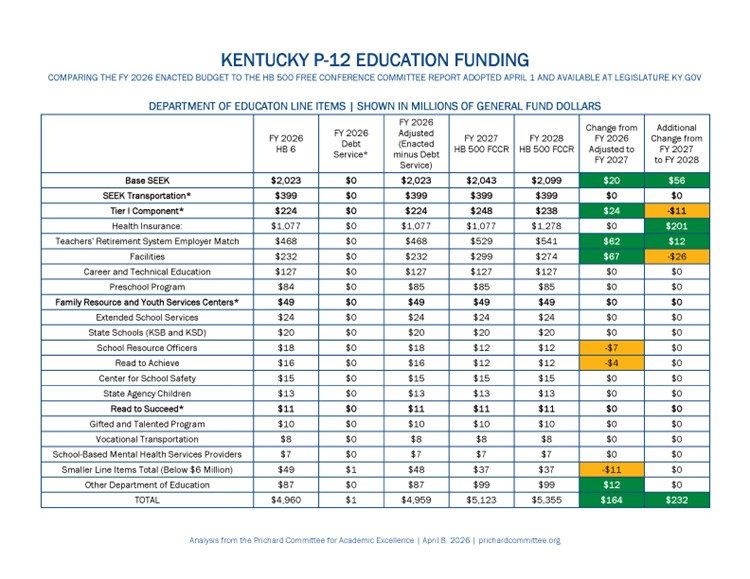
Full analysis of the enacted budget can be found at Prichardcommittee.org.
Progress, Gaps, and a Missed Opportunity
The 2026 session delivered important policy frameworks but left core Meaningful Diploma priorities only partially met. The most consequential gap sits at the front end of the pipeline: strategic investment in early algebra and middle school mathematics. HB 789 authorizes a comprehensive study, but Kentucky’s students – ranked 32nd nationally in 8th-grade math – cannot afford to wait on a study alone. Without targeted funding for teacher capacity and instructional leadership, the path to Algebra I by 8th grade will remain uneven – and with it, the path to the advanced coursework, credentials of value, and postsecondary attainment that make a diploma truly meaningful. The most important thing districts can be doing now is strong implementation of 2025’s HB 190, which requires districts to adopt advanced coursework plans for students fourth through twelfth grade.
Looking Ahead
Kentucky took real steps forward in 2026 – on assessment and accountability, principal leadership, and the bridge to postsecondary opportunity. But the framework still requires sustained investment in early math, advanced coursework access, and dual credit to turn graduation into a real on-ramp to upward mobility. Kentucky ranks 46th in postsecondary enrollment, 44th in attainment of associate degrees or higher, and 46th in median household income; by 2040, 75% of jobs leading to economic prosperity will require a postsecondary credential. A Kentucky diploma should be the turning point – the credential that opens the next door, and the next, until every graduate has a real pathway to the life they want to build.